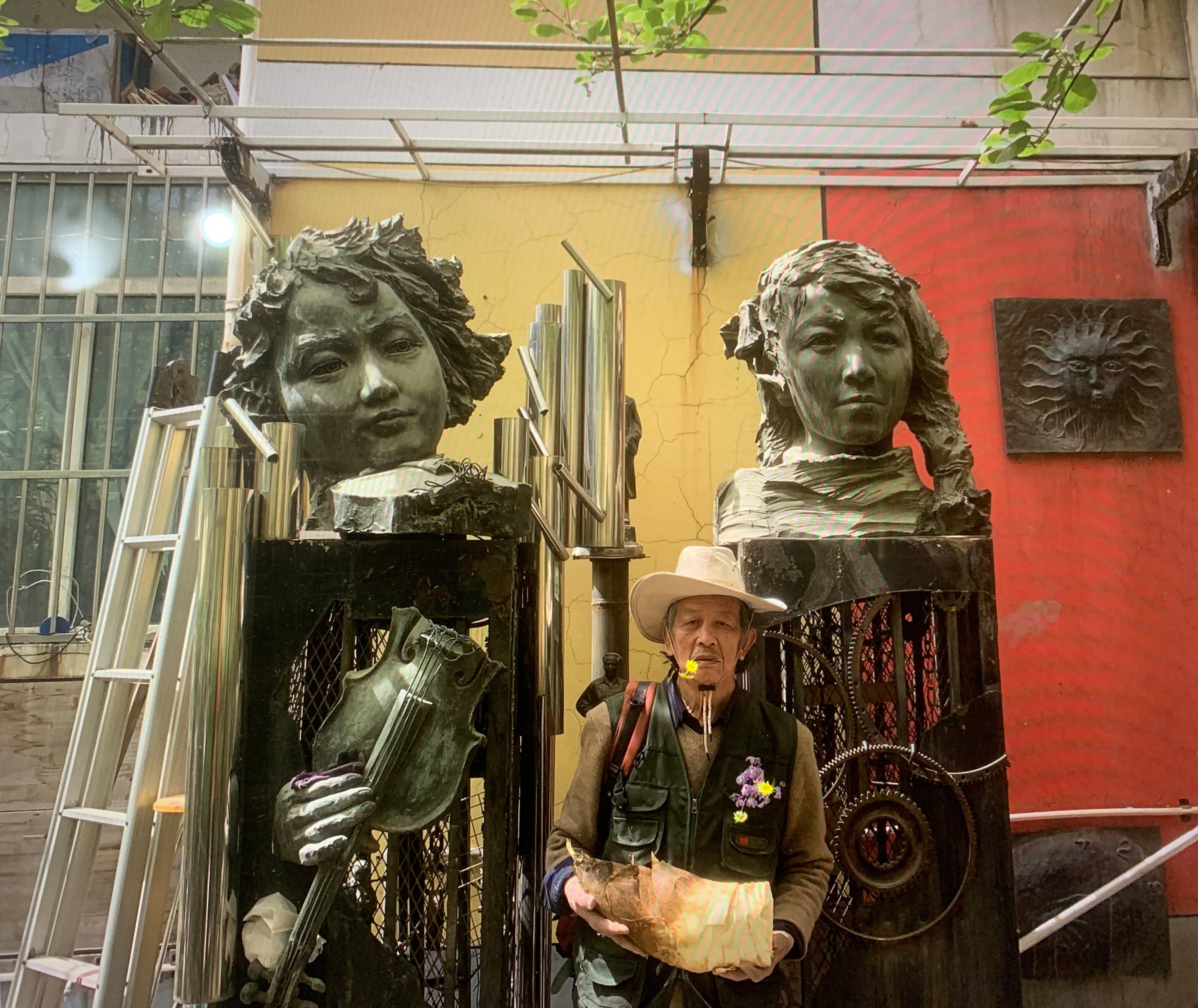
Yan Zhengxue with his sculptures of Zhang Zhixin and Lin Zhao
The Thorns of the Iron Rose Remain Sharp: Commemorating the Second Anniversary of Artist Yan Zhengxue’s Passing
By Jiang Xue
中国民间档案馆 China Unofficial Archives is a reader-supported publication. To receive new posts and support our work, please consider becoming a free or paid subscriber.
On an April day in Changping, Beijing, near the Longze station on Subway Line 13, lies the Tianhuiyuan residential community. A few visitors walked to a corner of Building 5 to visit Zhu Chunliu. Now 82 years old, she is the widow of the artist Yan Zhengxue, who passed away two years ago.
This is the Iron Rose Garden—the home ofYan Zhengxueand his wife, and the resting place for the sculptures ofLin Zhaoand Zhang Zhixin, two of China’s most iconic female dissidents. In 1968, Lin Zhao was executed by firing squad in Shanghai. In 1975, Zhang Zhixin was killed in Shenyang during the Cultural Revolution; fearing she might shout out slogans before her execution, the authorities ordered the executioners to slit her throat.
The two bronze busts, standing 2.5 meters tall including their steel bases, have weathered years of wind and rain. They have lost the pristine gleam they had when first installed in September 2010, taking on a more weathered, historic patina. The two women gaze resolutely into the distance. Etched onto their bronze figures are symbols of imprisonment—chains, gears, a broken violin, and imagery representing the letters Lin Zhao wrote in prison using her own blood. Yan Zhengxue and Zhu Chunliu were the creators of these two sculptures.
Yan suffered a sudden stroke in September 2023. Two years ago, on May 28, 2024, the 80-year-old passed away at his home in the Iron Rose Garden, surrounded by his family and leaving no final words. Even during his severe illness, the authorities never relaxed their surveillance. Because his passing fell close to the politically sensitive anniversary of June 4, few people were permitted to attend his funeral.
Since its unveiling in 2010, the Iron Rose Garden in Beijing served for a time as a landmark site for China’s civil rights defense movement at the turn of the century.
Around 2006,independent director Hu Jiereleased his documentaryIn Search of Lin Zhao’s Soul, bringing the story of Lin Zhao—who was implicated in theSparkcase, imprisoned, and ultimately executed—to a wider audience. According to contemporary articles, Lin Zhao’s close friends from her days at Peking University, such as Zhang Yuanxun andGan Cui, alongside long-time memorial organizers like Zhu Yi (who went by the online moniker “Guardian of the Memorial Garden”), called for the creation of commemorative sculptures for Lin Zhao and Zhang Zhixin, and even launched a public fundraising campaign. The responsibility of bringing these sculptures to life ultimately fell to Yan and Zhu.
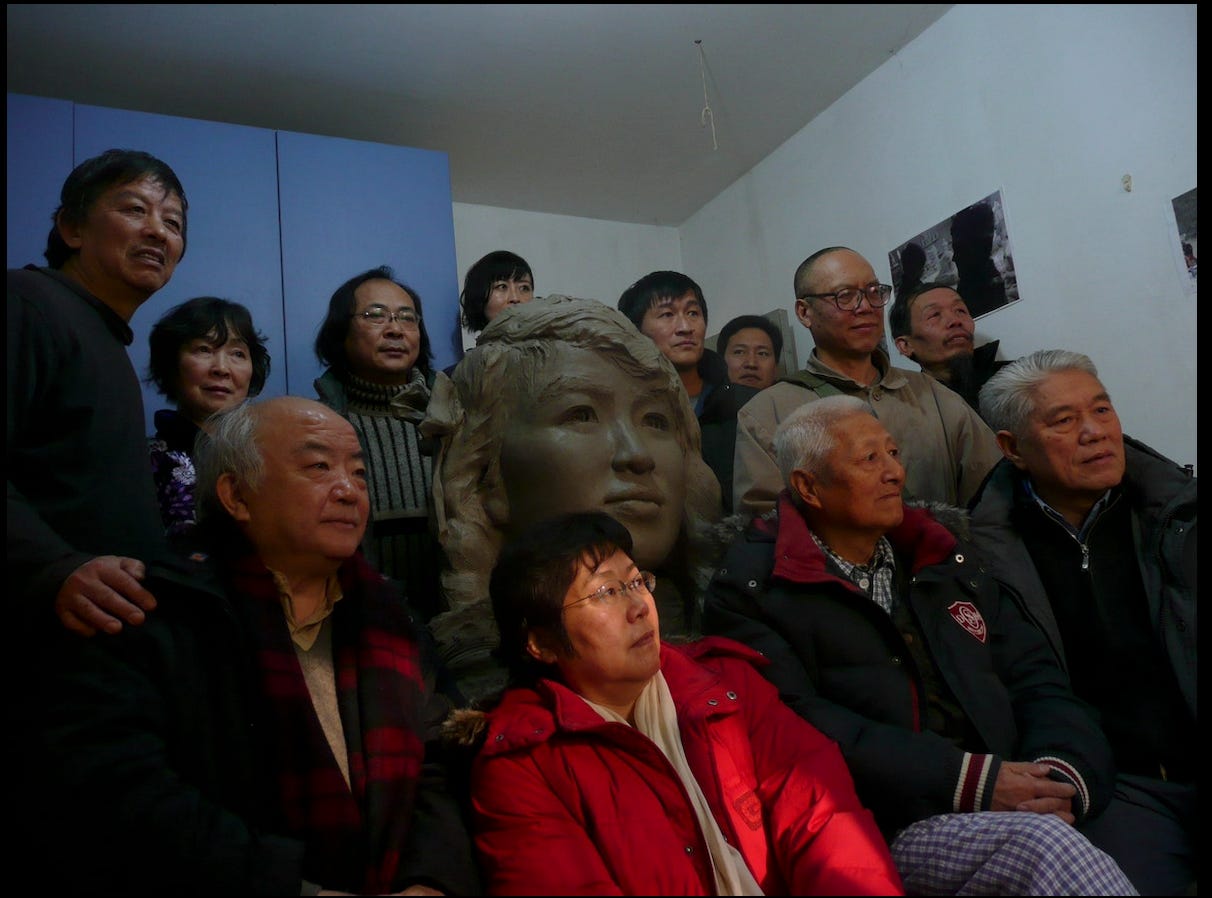
A gathering for the unveiling of the sculptures of Lin Zhao and Zhang Zhixin in May 2010.
Initially, the two sculptures were crafted from pure white fiberglass. The design process was collaborative, with the drafts undergoing several revisions based on public feedback. Following their completion in 2010, an unveiling ceremony was held at Yan Zhengxue’s home. To avoid police harassment, they deliberately sidestepped the sensitive anniversary of Lin Zhao’s death on April 29, choosing instead to hold the event on May 2, 2010.
Independent directorLaohu Miao (Tiger Temple)captured the moment in hisdocumentaryThe Guardian of the Iron Rose Garden. On that day, forty to fifty people crowded into the tiny courtyard, which measured only a few square meters. Among them were Du Guang, an 82-year-old reformist scholar within the establishment who passed away in 2023, retired Peking University professor Qian Liqun, and numerous active younger scholars and civil rights activists.
At the ceremony, Gan Cui and Wang Shuyao unveiled Lin Zhao’s statue. These two octogenarians were Lin Zhao’s former classmates at Peking University, and Gan Cui had been her lover. Zhang Zhixin’s statue was unveiled by her younger sister alongside Du Guang. When the drapes were lifted and the two pristine white statues were revealed, the crowd fell silent, and tears welled in the eyes of the elderly guests.
In the Beijing of 2010, the event felt like a long-delayed funeral for Lin Zhao and Zhang Zhixin—and for the countless other righteous souls who perished during China’s Mao era. When the artworks were made, China’s political climate was relatively permissive. Civil rights activists, scholars, lawyers, and journalists from across the country were active in Beijing. People gathered not only to honor early pioneers of democracy but also to foster a small community bound by shared values.
Following the initial unveiling, Yan took feedback into account and recast the two sculptures in bronze, hosting a second unveiling ceremony in September of that year. Unlike the white fiberglass, the bronze statues carried a sense of historical weight and could withstand the elements. From then on, Lin Zhao and Zhang Zhixin—the two women Yan likened to iron roses—had officially made their home in the Iron Rose Garden.
Originally, Yan, Zhu, and their supporters had no intention of keeping the sculptures at their home. They had envisioned donating them to Peking University and Renmin University, the respective alma maters of Lin Zhao and Zhang Zhixin. However, the plan failed; they were barred from even entering the campus gates. In the spring of 2010, they planned to display the statues publicly at Beijing’s 798 Art Zone and permanently install them on the district’s sculpture street, but government intervention halted the project. Ultimately, the backyard of Yan Zhengxue’s home became their only sanctuary—which is how the Iron Rose Garden earned its name.
With no legal grounds left for the authorities to evict them, the Iron Rose Garden evolved from a private residence into a semi-public space. In earlier years, back when a Chinese civil society still had room to exist, many events were held beneath the sculptures of Lin Zhao and Zhang Zhixin—including memorials for post-1989 exiles like Liu Binyan (1925–2005) and Fang Lizhi (1936–2012).
Along the wall leading into the Iron Rose Garden stands a row of black iron installations. Yan Zhengxue, who embraced Christianity in his later years, named this structure God’s “Narrow Gate.”
From its inception, the Iron Rose Garden stood as a symbol of resistance, bringing its owners honor but also immense misfortune. Yan faced frequent threats, both overt and covert. In Laohu Miao’s documentary, Yan helplessly recalled an incident where someone poured urine down from a third-floor window while he was working in the courtyard, attempting to force him to stop.
In 2011, following the Beijing Jasmine Rallies (small-scale pro-democracy protests inspired by the Arab Spring), authorities ordered that the two sculptures in the Iron Rose Garden be covered in plastic sheeting. They remained hidden for an entire year. When Yan Zhengxue finally removed the plastic in 2012, he chose a highly symbolic date:Jingzhe(the Awakening of Insects) on the lunar calendar, a day signifying spring, renewal, and the promise of change.
Almost every year around the anniversary of Lin Zhao’s death in April, visitors would come to the Iron Rose Garden to lay flowers and pay their respects. Sometimes, the mere presence of high-profile or sensitive visitors would put the authorities on high alert. For Yan, warnings and surveillance from the domestic security police, alongside random acts of intimidation, followed him like a shadow.
“At 12:00 PM while at home, there was suddenly a thunderous crash. Thinking it was an earthquake, I ran outside and discovered that a car had smashed into the eastern wall. The wall cracked open, and three paintings were destroyed. A public security officer didn’t arrive until around four o’clock.”
This incident took place at the Iron Rose Garden on March 2, 2013, when a vehicle within the residential compound plowed into the first-floor wall of Yan Zhengxue’s home. Xu Chongyang, a civil rights petitioner and eyewitness, wrote down this testimony. At the time, there were roughly twenty to thirty guests inside the house. Fortunately, the steel framework of the “Narrow Gate” outside absorbed some of the vehicle’s impact; otherwise, the consequences would have been catastrophic.
The sudden crash caused significant damage to the Iron Rose Garden. Yan reported it to the police, demanded an investigation, and eventually took the Beijing traffic police to court. While he ultimately received financial compensation, the true cause of the crash was never uncovered.
Perhaps it was a matter of temperament and destiny, but as an artist, Yan spent his entire life fighting against an invisible adversary. Born into a family with a bad class background, he suffered the misfortune of seeing his father’s house ransacked in 1957. He was later admitted to the Affiliated High School of the Zhejiang Academy of Fine Arts, where he received professional training. When the Cultural Revolution broke out, he left his hometown and drifted through places like Xinjiang, narrowly surviving multiple brushes with death. Zhu Chunliu traveled thousands of miles from Zhejiang to Xinjiang to marry him. From that moment on, they shared a lifetime of hardships, never parting regardless of how bleak things became.
Following the end of the Cultural Revolution, Yan Zhengxue enjoyed a period of relative peace. Alongside his daughter, Yan Yinhong—who also graduated from the Zhejiang Academy’s affiliated high school before studying traditional Chinese painting at the China Academy of Art—he held a joint exhibition titled “Two Generations” at the National Art Museum of China. Yan Yinhong later became a well-known contemporary artist in her own right, always maintaining a deep understanding and support for her father’s work.
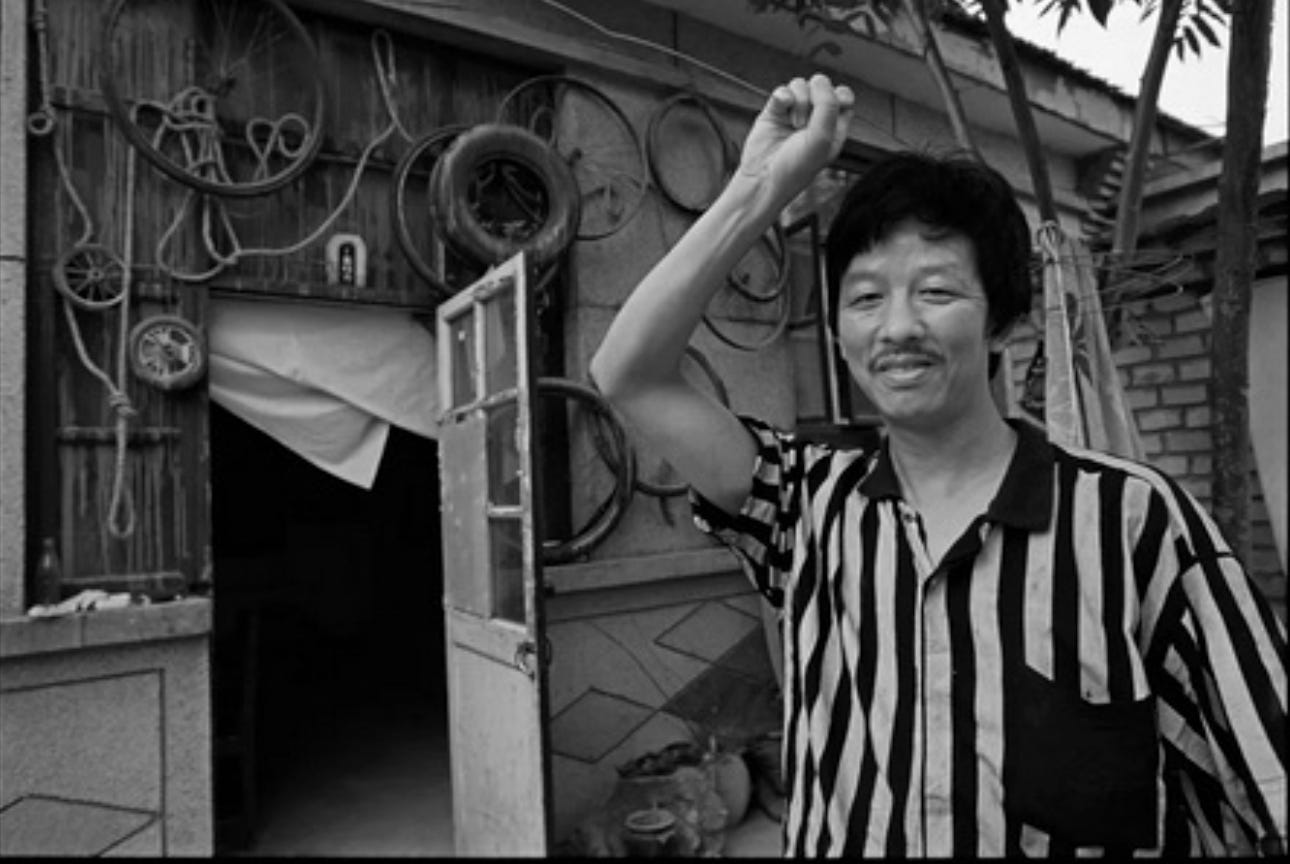
Yan Zhengxue at the Yuanmingyuan artists’ village in Beijing in 1993.
Around 1992, a community of young artists began to coalesce near the ruins of the Old Summer Palace (Yuanmingyuan) in Beijing, embodying a vanguard, avant-garde spirit. By then, the 49-year-old Yan Zhengxue had joined the ranks of the “Beijing drifters.” He became the oldest resident of the painters’ village and was elected its “village chief.” In 1994, his refusal to back down in a legal dispute with the public security bureau resulted in severe retaliation; he was sentenced by the Beijing Municipal Public Security Bureau to two years of reeducation-through-labor at the Shuanghe Farm in Heilongjiang.
In the labor camp, he was subjected to torture by electric shock. His friends managed to pressure the prison authorities by threatening to expose his treatment to international media, successfully securing his right to use painting materials while incarcerated. Out of sight of the guards, he managed to create dozens of abstract paintings and, with the help of family and friends, smuggled them out of the camp. He later chronicled his grueling experiences in an autobiography titledStrangers in Yin and Yang.
In 2006, Yan championed civil rights causes for residents in his hometown of Taizhou. Because of his activism and writing, he was charged with inciting subversion of state power and sentenced to three years in prison. Shortly after his release, he and his wife began planning the creation of the Lin Zhao sculpture.
In 2018, at the age of 74, Yan Zhengxue held his “Great Northern Wilderness Art Exhibition” in Beijing, finally unveiling the dozens of large-scale paintings he had secretly created in the labor camp. Utilizing heavy, sweeping strokes of Chinese ink, the paintings were eerie, grotesque, and visually arresting. He gave the pieces titles likeSubterranean Fire,Dancing with Wolves, andFlowers of Evil, all reflecting themes of resisting totalitarianism and pursuing freedom. To prevent government interference, the exhibition had to be kept low-key, though the discussions surrounding it were captured in Laohu Miao’s documentary.
In contrast to the fierce impression left by his actions and artwork, historical video footage reveals a man who was far from aggressive. With his long, disheveled, graying hair and his habitual photographer’s vest, he spoke softly, his expression carrying a quiet note of sorrow and hardship.
Following his passing, one of his Christian friends, Xu Yonghai—an elder in a Beijing house church—rushed to the home to help the family manage funeral arrangements. However, Xu was barred from attending the memorial service. Meanwhile, friends who received the family’s official obituary noticed its opening line:
“What my heart praises as good, though I die nine times for it, I shall never regret.”
This line, taken from the classic poemLi Sao(The Lament) by the Warring States period poet Qu Yuan, expresses an unyielding commitment to one’s ideals. As his friends noted, the quote serves as “a precise and profound summary of the life he lived.”
Today, the Iron Rose Garden is quiet. Zhu lives there peacefully, kept company by the sculptures of Lin Zhao and Zhang Zhixin, as well as Yan’s stunning, avant-garde paintings. Though the man has passed, his spirit endures. On May 28, 2026, she and her family are looking back on her husband’s life in deep and loving memory—a life just like that iron rose, forever bearing its sharp thorns.
中国民间档案馆 China Unofficial Archives is a reader-supported publication. To receive new posts and support our work, please consider becoming a free or paid subscriber.