July 1st of this year marked
the ten-year anniversary of Hong
Kong's Return to Chinese
Sovereignty. The front page
headline of the current issue is
"Penetrating the Ten-Year
Anniversary of Hong Kong's Return
to Chinese Sovereignty". From the
chief editor, Hu Ping put out the
article of "Time Can Only Raise
the Value of Evilness". In the
column of "Front Page Headline",
Beijing Spring issued the articles
of "Basic Law and Basic
Lawlessness of Hong Kong" written
by Liu Zili from Beijing; "Hong
Kong Repatriated Students of Fa
Lun Gong and ¡®One Country, Two
Systems'" written by Wu Fan;........
Table
of Contents
From the Chief Editor
03. "Time Can Only Raise the Value
of Evilness" / Hu Ping
From the President
04. Tragedy Really Won't Come
Again? / Wang Dan
Front Page Headline:
Penetrating the Ten-Year
Anniversary of Hong Kong's Return
to Chinese Sovereignty
06. Basic Law and Basic
Lawlessness of Hong Kong / Liu
Zili (Beijing)
11. Hong Kong Repatriated Students
of Fa Lun Gong and "One Country,
Two Systems" / Wu Fan
14. The Reverse of Hong Kong's
Press Freedom / Zhang Jing
Political Situations in China
17. Chinese Communist Party
Resists Nationalization of
Military / Lu Gengsong (Shandong)
23. Democracy Has Become a Noun
Game / Fu Guoyong (Zhejiang)
About China
27. The Moral Responsibility of
News Media / Qiao Xinsheng (Wuhan)
28. The Lawyer's Pleading Notes in
the Case of ¡®Li Yuan Long' / Li
Jianqiang (Shandong)
The Fifty-Year Anniversary of
Anti-Right Movement
31. The Termination of Liberalism
and the Ebb of Communism / Fang
Lizhi
39. The Beginning of Great
Catastrophe in Contemporary China
/ Xu Liangying (Beijing)
43. The Social Democratic Idea of
Zhou Juzheng / Ge Li and Cui
Yousheng (Szechuan)
46. Tracing the Rightists'
Situation (5) / Zhou Suzi (New
Zealand)
Quest for Theory
51. Anemic Economics / Hu Ping
54. Communism Is Precisely
Terrorism / Yu Jie (Beijing)
International Vision
60. Historical Comparison of Mass
Demonstration Suppressions between
Chinese Government and the United
States Government / Fang Yan
65. The Concern That Hungary Paid
to Tibet / Zhong Shi (Hungary)
Historical Testimony
68. The Communist Party Changed
Face / Tu Longzhi
72. The True and Fake Story of
Luding Bridge / Dong Fu (Chengdu)
75. I Look At the ¡®Seven-Thousand
People Conference' / Zhang Heci
(Australia)
The Wall of Democracy
78. Pro-Democracy Movements and
Political Refugees / Tang Yuanjun
81. Criticisms on Pro-Democracy
Movements Have To Be Appropriate /
Liu Guokai
86. The Mission of Pro-Democracy
Movement Politician / Wang Xizhe
87. General Knowledge about China
(12) / Chen Pokong
Readings
90. Listen to Zhao Ziyang's
Discussion on Reformation / Shu
Chong
93. The History Crevice from the
Ancient Time through Presence /
Zhang Yaojie (Beijing)
Literatures:
96. The Bleached Years / Northern
Cloud (Thailand)
Brief Messages
98. Dalai Lama Delivered a Speech
in Sydney / Qin Jin (Australia)
99. Cooperation Is A Way Out of
Chinese Pro-Democracy Movement /
Tian Mu (Germany)
101. Brief Messages
Readers, Writers, and Editors
Letters Received
Members of Beijing
Spring's Advisory Board
Fang
Lizhi, professor of physics at
University
of Arizona. As the former vice president of
Chinese University of Science and Technology,
he inspired the 1989's Chinese Democracy movement
and then was forced to seek refuge in the
American Embassy for about a year after the
June 4 crackdown.
Guo
Luoji, a leading liberal theoretician who
was driven out of Beijing by Former Chairman
Deng Xiaoping because of his political opinion.
In 1992, he sued the Chinese government for
human rights abuses in a Federal Court of
law. Now he is a visiting scholar at Harvard
University.
Smarlo Ma Smarlo Ma is pen name of Mr. Yi Ma.
Joining the CommunistParty of China
in 1937, he became Director of the
Library of the Anti-Japanese Military
and Political College in Yan-an in 1938.
He formally left the Party in 1943. as
a well known expert on the history of
the Communist party of china, he has
often been invited to present papers
in international conferences of Asian
specialists. He has published mora than 20 books.
Perry Link,
professor of East Asian Studies at Princeton
University. He specializes in 20th-century
Chinese literature and is very concerned with
human rights condition in Mainland China.
Liu Qing, Chairman
of the Executive Committee of Human Rights
in China. As a democracy promoter and a close
ally of Wei Jingsheng, he had been jailed
by Chinese government for almost ten years.
Andrew Nathan,
professor of Political Science and Director
of East Asian Institute at Columbia University.
His teaching and research interests include
Chinese politics and foreign policy, the comparative
study of political participation and political
culture, and human rights. He has published
numerous books and articles on China's politics.
Situ Hua,president
of the Hong Kong Alliance in Support of Patriotic
and Democratic Movement in China. Mr. Situ
is a member of the Hong Kong legislature and
an important leader of the Democratic Party
of Hong Kong.
Su Shaozhi,
chairman of Princeton China Initiative. Once
served as the director of the Institute of
Marxism-Leninism-Mao Zedong Thought of the
Chinese Academy of Social Sciences, he is
a leading liberal political theoretician in
China.
Su Xiaokang,
a Chinese writer well known for his epic The
River's Elegy, a critical television program
about China's political and cultural evolution.
As an active participator in the 1989 democracy
movement, he was forced to leave China. Now
he is a fellow of the Princeton China Initiative
and publisher of the bi-monthly journal "The
Democratic China".
Yang Liyu,professor
of East Asian Studies at Seton Hall University
Yu Ying-shi,
professor of history at Princeton University.
Mr. Yu has been a leading critic on the tyranny
of the Chinese communists after he left China
in 1950. After the Chinese government crackdown
on the Democracy Movement in 1989, he devoted
himself into helping the fled Chinese activists
to settle down in the U.S and setting up the
Princeton China Initiative.
Members of Beijing
Spring's Editorial Board
Yu
Dahai, Publisher of Beijing Spring and
assistant
professor of economics at Tufts University.
Graduated from Beijing University and received
a Ph.D. degree from Princeton University,
he served as Chief Editor of Beijing Spring
from June 1993 to June 1996 and then as President
from June 1996 to September 2002. He is founding
president of the Chinese Economists Society
and former president of the Chinese Alliance
for Democracy and the China Spring magazine.
Wang Dan,President
of Beijing Spring since September 2002. As
a student leader from Beijing University in
the 1989's Democracy Movement, he was on the
most wanted list of the Chinese government
after the June 4 crackdown. After being imprisoned
for political reasons from July 1989 to February
1993 and again from May 1995 to April 1998,
he came to the United States ad is now a doctoral
student in Harvard University.
Hu Ping,Chief
Editor of Beijing Spring since 1996 and a
regular commentator for Radio Free Asia. Received
a Master's degree in philosophy from Beijing
University and studied at Harvard University,
he was once the Chief Writer of Beijing Spring
from June 1993 to June 1996. He is former
president of the Chinese Alliance for Democracy
and the China Spring magazine.
Chen Kuide,
fellow of Princeton China Initiative and program
host for Radio Free Asia. As once the Chief
Editor of Shanghai's Thinker magazine, he
actively took part in the 1989 democracy movement.
He later received a Ph.D. degree in philosophy
from Fudan University.
Zheng Yi,member
of the Princeton China initiative and a famous
political critic. He once wrote articles to
expose the cannibalism in Guangxi during the
Great Cultural Revolution in China. As an
important leader of the 1989 democracy movement,
he was forced to leave China in 1992.
Xue Wei, Manager of Beijing Spring since
1993.
He was imprisoned in Sichuan for ten years
for "counter-revolutionary activities"
in the 1970's. He was among the founding members
of the Chinese Alliance for Democracy and
the China Spring magazine and has always served
as a leader in promoting Chinese Democracy
Movement dating back 1982.
This Month
Brief of No. 171
Translated by Soo Chong
1. Front Page Headline:
Penetrating the Ten-Year Anniversary of Hong Kong's
Return to Chinese Sovereignty
July 1st of this year marked the ten-year anniversary
of Hong Kong's Return to Chinese Sovereignty. The
front page headline of the current issue is
"Penetrating the Ten-Year Anniversary of Hong Kong's
Return to Chinese Sovereignty". From the chief editor,
Hu Ping put out the article of "Time Can Only Raise
the Value of Evilness". In the column of "Front Page
Headline", Beijing Spring issued the articles of
"Basic Law and Basic Lawlessness of Hong Kong" written
by Liu Zili from Beijing; "Hong Kong Repatriated
Students of Fa Lun Gong and ¡®One Country, Two
Systems'" written by Wu Fan; and "The Reverse of Hong
Kong's Press Freedom" written by Zhang Jing.
Hu Ping's article criticized and disputed over the
conversation that Deng Lin, the eldest daughter of
Deng Xiaoping, contributed in the interview about
¡®June 4th' in Hong Kong on the eve of ten-year
anniversary of Hong Kong's Return to Chinese
Sovereignty. Deng Lin said that the incident of ¡®June
4th' was a collective decision made by the then CPC
leaders, and people should not judge in a way that it
was a concrete responsibility of a certain leader. Hu
Ping pointed out Deng Xiaoping was the culprit of the
incident of ¡®June 4th', and it is futile for Deng Lin
to absurdly deny the fact. By acting in that reaction,
Deng Lin was only exposing her guilt in conscience. Hu
Ping believes that as time goes by, not only the
heinous sin of ¡®June 4th' has not been reduced, but it
is further extending instead. Under the terrorful
shadow of ¡®June 4th', China's economic development is
paying the price for serious social differentiation
and moral depravation, the growth of its national
power is bound to strengthen autocratic tyranny
together with gradually becoming a great threat of
human freedom and peace.
Liu Zili's article analyzed the origin and development
of CPC's "One Country, Two System". At the base of
revolution, Yanan, where it advocates revolutionary
revolt, has long been "One Country, Two System": it
carries out Bourgeoisie as regards to the party's rich
and powerful; and it carries out first, not afraid of
bitterness, and second, not afraid of death, as
regards to cannon fodder and small soldiers. The true
demand of proletariat revolution was not establishing
a proletariat country, but establishing the authority
of proletariat revolutionaries yearning for
bourgeoisie prerogative. While analyzing the problem
of ¡®mainlandized' Hong Kong or ¡®Hong-Kongized'
mainland, the author pointed out that under the
framework of the so-called "One Country, Two System",
it is not clear for now that Hong Kong is actually
accepting the political form of former British ruling,
or the ruling of Chinese political attribution.
Characteristics of Hong Kong such as freedom of
expression and freedom of association are British
characteristics; yet, Chinese characteristics have now
been extensively permeated, democratic freedom in Hong
Kong is being marginalized. Political guests of
Beijing and upstarts of Hong Kong are grouping into
one kind of mode that is different from the former
Hong Kong. Hong Kong's theory of "One Country, Two
System" is actually very blurry and unclear. Its
essential objectives are considering the legitimacy of
socialism and capitalism. Constitutionalism is the
pivotal point of solving the democratic problems in
Hong Kong and Mainland. Regardless of whether
returning to British sovereignty or expecting China's
democratic development, a ruling and a society that
preserves social justice have to be built; and this
expectation is encountering serious challenges.
Wu Fan's article especially analyzed a significant
event that happened on the eve of ten-year anniversary
of Hong Kong's return to Chinese Sovereignty: In
accordance with the "blacklist" that was provided by
the CPC, government of Hong Kong extensively
obstructed nearly thousand of Fa Lun Gong students and
ordinary public to enter Hong Kong by declining the
issue of visas, not allowing to board airplanes, and
forcefully up to violently repatriating. The author
pointed out Hong Kong carries out "One Country, Two
System" according to "The Basic Law". In the past ten
years, Hong Kong government has allowed the existence
and activities of Fa Lun Gong in Hong Kong, and it put
up with the free entering and departing of Fa Lun Gong
students at a certain level. Yet, Hong Kong
government's recent act of preventing nearly thousand
of Fa Lun Gong students and ordinary public to enter
the country had totally violated "One Country, Two
System"; the so-called "One Country, Two System" was
completely bankrupted with the incident of Fa Lun
Gong. Its causes were: the CPC was afraid of the
appearance of mass demonstrative groups and protesters
that were going to be made up of Fa Lun Gong students
on July 1, and it was in fear of the expansion of Fa
Lun Gong momentum in Hong Kong.
As an associate of news media, Zhang Jing had lived in
Hong Kong for a long period of time, her article made
use of numerous facts to point out: Hong Kong's return
to Chinese Sovereignty has been 10 years, and the
freedom of press has been shrinking. Hong Kong's
associates of news media are those who are making
decision in between intuitive knowledge and rice bowl.
They have to carry out their own bounden duty on one
hand, trying hard to defend the major effects that
"crownless emperor" insists: supervising the
government; making truth known to the public; fighting
for more rights of knowing the truth for Hong Kong
people; enhancing mutual understanding among people.
On the other hand, in order to keep their jobs, they
usually have to act in accordance with the ¡®face
complexion' of boss and superior. Beijing is not the
one who intervene Hong Kong's press freedom, but the
bosses of news media institutions in Hong Kong. When
the freedom of news media conflicts with commercial
interest, boss would naturally put more emphasis on
commercial interest, intervention of Beijing was not
necessary after all. The current freedom of news media
in Hong Kong is more reverse than 10 years ago when
Hong Kong was returning to Chinese sovereignty. The
author pointed out that, the CPC understands that
directly controlling the news associates in Hong Kong
is certainly not an easy task. Controlling the boss
and senior leaders of news media will be much easier;
they use both authority and money to threaten and
entice, and to make wishes by conferring officials.
Some proprietors became professors or advisers of some
famous colleges in China all in a sudden; some
stretched across both political and commercial
boundaries, and reaped both reputation and profit. The
biggest stress for reporters who carried out sensitive
reports towards the CPC comes from the deadly threat
that may happen any moments. Some were cut off arms,
some encountered violent threat, some associates'
computers and stationery equipments were destroyed. In
brief, Hong Kong's freedom of news media is reversing.
In order to avoid lamentable ending, CPC's one-party
autocracy has to be ended in the whole China.
2. Chinese Communist Party
Resists Nationalization of Military, Play with the
Noun Game of Democracy
In the column of "Political Situations in China",
Beijing Spring have issued two articles; they are,
"Chinese Communist Party Resist Nationalization of
Military" written by Lu Gengsong from Shandong and
"Democracy Has Become a Noun Game" written by Fu
Guoyong from Zhejiang respectively.
Lu Gengsong's article was the fourth chapter of his
series of articles - ¡®Discussion on Military
Nationalization'. First of all, the author mentioned
about "People's Liberation Army Daily" (PLA Daily)
issued the article of "The Historical Inspiration on
Maintaining the Quality of People's Army" on June 18,
calling on the liberation army to "insist on resisting
military nationalization". This kind of doing, first
of all, is contrary to the trend of history; second,
it is contrary to the people's mind; third, it is
contrary to its own constitution and law; and fourth,
it is contrary to the tendency of worldwide military
revolution. The author illustrated that since July
2007, Ministry of National Defense in Taiwan abrogated
the "ideology" and "leader" in the "Five Convictions
of Military Personnel", and changed them into "nation,
responsibility, honor". This act was made in
accordance with "nation, responsibility, honor" three
major convictions of the military in the United
States, corresponding with the goal of nationalizing
military. On the other hand, the dictatorship of
mainland China is still firmly holding up with the
idea of "the absolute leadership of party to the
military". Regardless of whether we are judging from
the viewpoint of historical development, from the
contents of constitutional democracy, or even from the
constitution that was made by the CPC itself, CPC has
no any other reasons to "absolutely lead military".
The author pointed out that after the article in "PLA
Daily" was issued, it suffered a lot of criticism from
netizens. "China.com" conducted a survey on people who
had read the article; among the six choices of
"admiring", "smiling", "feeling sorry", "angry", "pass
by" and "disgusting", people who selected "angry" and
"disgusting" were the most. The problem of
nationalizing military has long been firmly believed
in the Chinese constitution that "the armed force of
the People's Republic of China belongs to the people";
"the nation carries out united leadership towards
defense activities". CPC's resistance on military
nationalization has also violated the tendency of
worldwide military revolution, causing the theory of
military affairs vulgar, studies of military affairs
not practical, military recruitment fully corrupted on
the field of choosing people; the above have baffled
the fourth military revolution.
Fu Guoyong thinks that the contemporary China has
entered into an era of afterward Utopia with no dreams
and no ambitious aims. Nouns such as democracy,
freedom and human rights that had been rejected are
starting to appear in the conversations and written
documents of officials. Yet, we should not be puzzled
with this false phenomenon, believing that they would
really like to accept these values. "Qiu Shi" magazine
has issued an article "Unswervingly Follow the
Democratic Politics of Socialism with Chinese
Characteristics", adding two limited phrases of
"Chinese Characteristics" and "Socialism" in front of
"Democratic Politics" means the competitive democracy
is not suitable for the current political situation in
China. Admitting the necessity of democracy on one
hand, twisting-and-kneading as well as holding lute in
the arm on the other hand to play with the noun game.
The author pointed out that, ordinary citizens who
live on the mainland should be the ones who answer the
question of whether democratic system is "suitable" or
"unsuitable" for China; the "proletariat democracy"
(or "socialistic democracy") of which its contents had
been hollowed not only is not able to guarantee the
freedom of gathering, associations, expression,
publication and strike, but furthermore does not allow
the existence of opposition parties, and reject to
competitive suffrage; ¡®pad its strength' is only a
noun game that deceives people. In the recent years,
new nouns that are popular including "harmonious
society" and "the viewpoint of scientific development"
have all lost the spearhead that treats the whole
society as enemy and traverses above the whole
society, this, at least, indicates that China is in
the process of gradually making changes; a new social
structure has started to appear, the political
authority is facing a great challenge, old-style
ideology and language have already been hard to adapt
to changes, the noun game of democracy is a phenomenon
that was produced in the transition.
3. Continue To Commemorate
the Fifty-Year Anniversary of Anti-Right Movement
This year marks the fifty-year anniversary of
Anti-Right Movement, Beijing Spring reported
commemorative activities worldwide in every issue, and
issued its related commemorative articles. In this
current issue, we reported the "Destiny of
Contemporary Chinese Intellectuals: Commemorating the
Fifty-Year Anniversary of Anti-Right Movement
International Symposium" that was held in Los Angeles,
the United States on June 29 ¨C 30; as well as the
"Commemorative Seminar of Fifty-Year Anniversary of
Anti-Right Movement" which was held in the editorial
board of New Times Weekly in Auckland, New Zealand on
June 30. In the column of "The Fifty-Year Anniversary
of Anti-Right Movement", we have issued the articles
of "The Termination of Liberalism and the Ebb of
Communism" written by Fang Lizhi, member of advisory
board of Beijing Spring; "The Beginning of Great
Catastrophe in Contemporary China" written by Xu
Liangying, researcher at the Chinese Academy of
Sciences; "The Social Democratic Idea of Zhou Juzheng"
written by Ge Li and Cui Yousheng from Szechuan; and "
Tracing the Rightists' Situation" written by Zhou Suzi
from New Zealand.
Fang Lizhi's article was his speech manuscript of the
"Fifty-Year Anniversary of Anti-Right Movement
International Symposium" which was held in Los
Angeles, United States, it composes of two articles
that the author wrote in 2004 and 1999.
The first article is the recollection of the memory of
"Historical Symposium of Anti-Right Movement" that was
held in 1986. A small conference was held by Xu
Liangying, Liu Bin Yan, Li Shuxian and Fang Lizhi at
Xu's house in Beijing on November, 1986: It's been
almost 30 years for Anti-Right Movement, what could be
done? The unanimous opinion was to hold a "Historical
Symposium of Anti-Right Movement" in the spring of
1987. They discussed the subjects for the meeting and
the ways to organize the activity. Fang made a meeting
notice in accordance with the provided viewpoints, and
sent it out to potential participants after he made
alterations. This was the afterward black "notice"
that was collected in the materials of criticizing Liu
Binyan in the movement of criticizing "Bourgeois
Liberalization". On January 2, 1987, CPC Central
Committee transmitted the first document, opposing the
opening of bourgeois liberalization. One January 12,
the CPC Central Committee and the State Council
decided to reshuffle University of Science and
Technology of China (USTC), exempted the position of
Guan Weiyan as the president of USTC, repealed the
position of Fang Lizhi as the vice president of USTC;
on January 14, Shanghai Council of the CPC decided to
expel Wang Ruowang from the party; On January 16, the
Political Bureau of the CPC Central Committee issued a
communiqu¨¦ and accepted the request of Hu Yaobang
resigning from the post of general-secretary; On
January 19, Discipline Inspection Commission of the
CPC at Anhui Province decided to expel Fang Lizhi from
the party; On January 25, Discipline Inspection
Commission of the CPC "People's Daily" decided to
expel Liu Binyan from the party.
The other article was the record of the two great
trends of liberalism and communism dashing into each
other during the 1957 Anti-Right Movement. The 1950s
Beijing University was like the 1910s, it was the land
of various spread of thoughts dashing into each other.
Different from the 1910s, 1950s ideology of the
dominant had already been Marx Karl's communism as
well as Bolsheviks Revolutionary Theory of Lenin and
Stalin. Yet, the elements of liberalism were still
everywhere to be seen and to be sensed on the campus
of Beijing University. Communism and liberalism could
not be reciprocally formed. The verifying vigor and
methods of contemporary science as well as the
foundation of the ideology of communism are hard to
coexist. Therefore, the sequestration between the
young intellectuals who trended toward liberalism and
the CPC was destined to happen sooner or later,
"Anti-Right Movement" was only speeding up the
progress of sequestration. The Right-Wing youth in
Beijing University struggled for freedom in 1957, and
it was actually the same as students in Budapest
striking for freedom in 1956. The dash in China in
1957 terminated the liberalism that gradually came to
China, it also caused communism in China start to
deplete and ebb, vanishing in the heart of generation.
Xu Liangying's article measured the four catastrophes
throughout the history after the CPC took power: the
1957 Anti-Right Movement that struck one million
intellectuals; "Great Leap Forward", the great famine
which caused ten millions people starve to death; the
overthrow of "Proletariat Cultural Revolution" of the
"then authority who took the path of capitalism"
in1966; the great massacre of June 4, 1989. By
observing those four catastrophes, the later three
have cause-and-effect relationships with Anti-Right
catastrophe, in order to understand and do research on
contemporary Chinese history, history of Anti-Right
Movement is a pivotal point. The author thinks that
the root of Anti-Right Movement was the antagonistic
attitude that Mao Zedong held against intellectuals.
Anti-Right Movement officially set the number of
rightists to be five hundreds fifty thousands people;
and owing to ¡®implicated policy', victims were at
least five millions. In order to handle with
rightists, Mao Zedong established the ¡®reeducation
through labor' system, expropriated citizen's physical
freedom, compelled unlimited duration of imprisonment
and reeducation through labor as wishes without going
through law procedures. The other dire result of
Anti-Right Movement was that it destroyed morale
principles of human civilization. The whole society is
shrinking morally, right and wrong are reverse, black
and white are obscure, human nature encounters
trample. Rectifying anti-rightist campaign caused the
common practice of not being honest and trustful as
well as conveying false talk, empty talk and lies, it
also caused the lie that cheats oneself during the
afterward "Great Leap Forward"; and it reappeared in
another form during "Cultural Revolution". We can put
it in this way, "Great Leap Forward" and "Cultural
Revolution" were both the dire results of Anti-Right
Movement.
4. International Vision: The
Historical Comparison of Conducts between the Chinese
Government and the United States Government
In the column of "International Vision" of the current
issue, Beijing Spring have issued "Historical
Comparison of Mass Demonstration Suppressions between
Chinese Government and the United States Government"
written by Fang Yan as well as "The Concern That
Hungary Paid To Tibet" written by Zhong Shi from
Hungary.
Fang Yan's article raised a kind of viewpoint that has
circulated for a long duration of time: CPC's military
committed a massacre in Tiananmen Square on June 4th
1989, they had enforced and warned the demonstrators
in advance, and started to killed them afterwards,
that was legal; mass demonstrators checked the forces
in advance, and the forces fired back afterwards,
demonstrators were illegal. People who hold this kind
of viewpoint even illustrated and explained the
examples of government of the United States suppressed
mass demonstrators in the history, in order to show
CPC's killing was reasonable and legal. The article
made a contrast on the historical background of
suppressing mass demonstrations, the mean of carrying
out suppression, as well as the purpose achieved
between the Chinese government and the United States
government.
Not too long after the end of American Civil War, the
specter of communism was then straying in the United
States, during the period of 1873 to 1915, for almost
half a century a series of labor movements
continuously appeared in the United States, strike
then became a major mean of movement. The author did
not find fault with the death and injury that was
caused by suppressions of labor movement by the United
States, he only explained that those suppressions all
appeared under the background of communism movements
in the United States. On the surface of the long
struggle between employers and employees on the
problems of reasonability of wages was actually a
struggle of proletariats wanting overthrow bourgeois.
Suppressions launched by the government towards strike
should be seen as a necessity of protecting
human-rights values. The purpose of proletariat
autocracy was to perish the bourgeois and deprive
human rights of the bourgeois; this is totally
deviated from the human rights principles of the
United States. As long as it contains the tendency of
autocracy and violence, they have to be stopped no
matter the participants in those movements are labors,
farmers or upper class. This is exactly the substance
of government of the United States suppressing
proletariat movement. The lucky aspect about the
United States and France was that they eliminated the
danger of communism movements during its sprouting
stage. Besides, the article introduced the ways of
treating labor issues by government of the United
States as well as the ways to deal with anti-war
demonstrations.
Zhong Wen's article mainly talked about the activities
of Hungarian Tibet Support Association as well as the
concern that Hungarian paid to Tibet through
introducing the documentary -- "Tibet, the Exiled
Homestead" which was shot by Hungarians and was shown
during the 38th Hungarian Film Festival that was held
in Budapest in the spring of 2007.
5. Dispute over the Theories
of Overseas Pro-Democracy Movements
Beijing Spring had successively issued two articles
written by Xue Wei; they were "The New Issue of
Overseas Pro-Democracy Movement: Movement of Refugees"
and "The Left-Wing Childish Disease of Overseas
Pro-democracy Movements" in the June and July issues.
Those two articles have led to significant reactions
among overseas pro-democracy movement groups and
Beijing Spring readers. We issued three articles in
the column of "The Wall of Democracy" in the current
issue, they are "Pro-Democracy Movements and Political
Refugees" written by Tang Yuanjun; "Criticisms on
Pro-Democracy Movements Have To Be Appropriate"
written by Liu Guokai; and "The Mission of
Pro-Democracy Movement Politician" written by Wang
Xizhe. We hereby welcome other writers continue to
contribute articles in order to launch deep discussion
on the problem that was involved in Xue Wei's article.
Tang Yuan Jun's article analyzed the complicated
compositions in political refugees, pointing out that
new immigrants were mostly ordinary labors in China;
they came to the United States to strive for a better
way out of life. As for pro-democracy movements,
political refugee is a strength that will be more
easily to be attracted. On the other hand, under the
background of which the CPC has permeated the western
society, the ingredients of new immigrants are
becoming more and more complex. Various kinds of
stowaways apply for asylum regardless of any risks in
order to strike for a new life overseas, using
forgeable documents to apply for political asylum;
yet, after they succeeded in doing so, they threw
themselves into supporting the CPC in order to obtain
economical and political benefits in return.
Therefore, by deciding how to depend on political
refugee groups and make them become the backbone of
pro-democracy movements, is a question that we need to
treat seriously; timely and efficiently distinguish
between friends and hidden saboteurs will be the
symbol of pro-democracy movements getting matured.
Regardless of whether judging theoretically or
practically, "pro-democracy movement" groups which are
in the industry of political asylum are groups that
possess no democratic mechanism.
Liu Guokai's article proposed that some pro-communist
figures make use of the status of being a refugee in
order to enter the United States, and that caused a
total change in the political way of life in New York,
the strength of pro-communist has then become
increased. Xue Wei's criticism that was made against
pro-democracy fellows was way too harsh. Most
pro-democracy activists are struggling in their lives,
nobody paid "concern" to them, and how could they pay
concern to others. If we were to be critical, we
should have been critical of those who were at the
leadership position during the 1989 student movement
but completely put themselves into their individual
worlds and paid no concerns to the career of Chinese
Democracy after they arrived overseas, they are even
stingy about donating funds for people who were
holding candlelight vigil for ¡®June 4th' although they
are really rich. Most Fujian stowaways and other
different kinds of overstayed residents are neither
political refugees nor economical refugees. They took
risks and spent huge sum of money to come to the
United States in order to seek for a better life,
gathering monetary fortune regardless of any methods,
endanger the society as well as trample on
righteousness and axiom. Some people take the path of
pro-communist for depending on the CPC in the United
States in order to obtain individual benefits. As
regards to the great change of New York's political
way of life, the author thinks that it was a cautious
and secret act of senior Chinese leaders.
In Wang Xizhe's article, he believes that Liu Guokai
has not become the role of a powerful pro-democracy
movement politician by judging from the furious that
he expressed on the illegal immigrants who come from
China to the United States and they not only want
political asylum but also are pro-communist. The point
where Xue Wei was more considerate than Liu Guokai was
that he did not use the furious of a regular civilian
to fight for immigrants with the CPC, but to call on
grasping the benefits of being an immigrant, and using
the way of following its tendency to lead in order to
fight for immigrants with the CPC. Try every
possibility to educate and nurture illegal immigrants
in the process, make them close to pro-democracy
movements, understand pro-democracy movements,
sympathize pro-democracy movements, or even
participate in pro-democracy movements; transfusing
young and fresh blood for pro-democracy movements.
Fang Lizhi, professor of physics at University
of Arizona. As the former vice president of Chinese University of Science and
Technology, he inspired the 1989's Chinese Democracy movement and then was
forced to seek refuge in the American Embassy for about a year after the June 4
crackdown.
To the Editor:
The purpose of this letter is to say something positive about "Beijing Spring", and this is from
the
bottom of my heart. Over the past 8 years, I have read every issue of the journal. I would at
least
take a glimpse of the title and author of the "Beijing Spring" in the busiest of my times. I would
put every issue of "Beijing Spring" in my living room, making my guests, especially those from the
other side of the Pacific Ocean, become sleepless. One of the members of the Investigation
Committee of my case during the "Cultural Revolution" became a friend of mine and visited me
recently. He spent 3 sleepless nights in reading the "Beijing Spring" journal of the past 5 years,
and he read the journal more carefully than I did. It appears that this journal indeed has its
attractions, or charms, if I can use this word to describe this journal.
"Beijing Spring" is not ideal of course, and not all of the published articles are good ones;
however, the dedication of editors and authors to freedom, democracy, human rights and legal
system
is reflected in every printed word of the journal. This is exactly the attraction of the journal,
especially those readers who have been living in an environment of no press freedom. My thanks are
to those editors and authors who have provided such a window so that the darkness is no longer a
dream for quest of freedom, and more, thinking about the quest for freedom.
Fang Lizhi July 29, 2000
**********************
Yu Ying-shi,professor of history at Princeton
University. Mr. Yu has been a leading critic on the tyranny of the Chinese
communists after he left China in 1950. After the Chinese government crackdown
on the Democracy Movement in 1989, he devoted himself into helping the fled
Chinese activists to settle down in the U.S and setting up the Princeton China
Initiative.
To "Beijing Spring" Editorial Office:
Mr. Editor:
I have received the "7-Year Summary of Beijing Spring" and I would like to express my appreciation
of it. "Beijing Spring" covers a wide range of issues, while it can make in-depth coverage on all
of them. It is not an easy thing to do. Articles on current events are often very sharp and to the
point, and readers are able to obtain a clear idea on the most recent situation and trend in
Mainland China. This contribution is especially helpful to overseas readers, and is indicative to
readers in Mainland China. According to my knowledge, readers in Mainland China are anxious to have
access to your journal. One of my friends recently paid a visit to Xi'an, and detained and
interrogated by the public security bureau; and one of the charges for his arrest was that he sent
"Beijing Spring" journal to one of the dissidents in there. Later it was through the interference
of the US government was he released and returned to the US. I knew about this event in detail and
would like to release this information to you. Besides, articles in your journal on spiritual
analysis, theoretical debate have reached a very high academic level, which should win fair
appraisal. When intellectuals want to seek routes for resolving problems about China, "Beijing
Spring" should be one of the most valuable resources for them to resort to. On the other side,
"Beijng Spring" can be regarded as having inherited the traditions of "Xin Min Cong Bao" and "New
Youth".
I have just returned from a long journey and feel very tired, therefore I am stopping here. The
above words are for your reference only.
With my regards
Yu Yingshi July 31,2000
*********************
Yu Haocheng,well-known legal scholar, former head of
Qunzhong Press of China's Ministry of Public Security.
Beijing Spring: The True Voice of Free People
Yu Haocheng August 1, 2001
Mao Zedong once wrote an article titled 'JOn Uniformity of Public Opinion" .He understood well
that
he who controls public opinion controls people's thought and consequently the whole country.
Accordingly, the half -century totalitarian rule by the Chinese Communist Party created a "silent
China? After Beijing won the sponsorship of the 2008 Olympic Games, the CCP did not relax
political
grip as many had expected. On the contrary, it further tightened control over the news media.
Recently, it even violated an agreement and deleted the comments on human rights in Secretary of
State Powell's speech in Beijing, making it difficult for the Chinese people to know what he had
said.
Beijing Spring is one of the very few journals published by the overseas Chinese living in freedom
to report on the reality of the Chinese society and voice the true feelings of the Chinese people.
Just like Voice of America and Radio Free Asia, Beijing Spring is absolutely needed and not
substitutable for those who no longer want to act deaf and mute, especially for the Chinese
intellectuals. As CCP diplomatic and overseas Chinese affairs personnel as well as their
publications such as Overseas Chinese Daily are spreading all kinds of untruths to deceive the
overseas Chinese, I sincerely hope that Beijing Spring will become better and better. The voice of
free people should never be stifled, and I am hopeful that the time when the "sound of spring" is
heard in Beijing and allover China will come quite soon.
********************
Wang Ruowang, well-known Chinese writer.
Mr. Hu Ping, Chief Editor:
I have reviewed your letter of request for comments. Based on the contents of the "Beijing Spring"
from January to July, I am herein making the following evaluation:
Good articles:
"The Stormy 50 Years of New China" by Li Sheng Zhi, as published on the January issue. This article
utilizes abundant information, its analysis is objective, and the argument is credible.
"The Anti-corruption Show Conducted by the Chinese Communists" by Jin Feng on the April issue. This
article points directly to the target, and revealed the mega corruption scandal concealed by the
Communist Chinese authorities. The information is valuable.
"The Historical Mistake The Communist Chinese Government Made in Eliminating Private Ownership
System" by Zhu Zhezhong on the July issue makes good points and good comparisons. It reveals the
so~rce for the catastrophe in which tens of millions of Chinese people suffered and the false big
words of Zhu Rongji.
Something should be done about the Fa Lun Gong, and since April to June, on each issue, there has
been coverage of the event. There is an 18-page coverage on the April and May issues, while there
are 12 pages on the April issue alone. There is some repetition, and also words from outside of
the
topic.
Please always be aware of the orientation: reveal the criminal nature of the Communist Chinese
authorities and the realization of the ideology of the people.
The above is for reference only.
Wang Ruowang July 27, 2000
**********************
Kam Yiu Yu, weii-known political commentator, former editor in
chief of Wen Hui Daily (Hong Kong)
Let Us Give Beijing Spring
All the Possible Support
Kam Yiu Yu
August 10,2001
During the 1989 democracy movement and the June 4 massacre, I was filled with
anger and grief. As editor of Wen Hui daily in Hong Kong, I secretly
collaborated with a few trusted friends and had the four characters "tong
xin ji shou" (heart hurts, head sickens) printed on the front page of our
newspaper in order to condemn the criminal killings of students and the
suppression of democracy by the Chinese Communist Party. In 1991, I withdraw from CCP, a group I
had served for half a: century beginning with the War of Resistance against Japan, and drifted
over
the Pacific and came to the U. S. Thereafter, I continued to oppose CCP' s one -party totalitarian
rule and its harmful policies and support China's democracy and freedom movement.
Before coming to the U. S. , I was a bit worried, because I was not sure whether, once settled in
the U. S. , I could still have publications to read that report on China's democracy and freedom
movement. Without this kind of publications, I would be insulated from China and forced to give up
following and supporting the movement. Life would be without meaning, political influence would be
unrealistic, and hope would be lost.
I was therefore pleasantly surprised when I saw Beijing Spring magazine. Its
contents showed that the forces of democracy and freedom continued to expand
within China抯 social and academic circles, and that the people continued to wage
their tireless, fearless struggle even after the June 4 massacre. The magazine
also exposed, documented and criticized CCP抯 suppression of democracy movement,
both through imprisonment and through propaganda, throughout China, and reported
on and encouraged Chinese pro -democracy activities allover the world, including
U. S., Europe and Asia.
China's internal and external situation can be so summarized: CCP抯 winter has
arrived. If so, how can Beijing's spring be remote? Those of us who have been
promoting democracy and freedom from overseas can see that we indeed have
helped and encouraged the people in China. At the same time, we clearly need to
do more and better. As writer, we must now make more effort. More specifically,
we must give Beijing Spring all the possible support, so that the friends at
Beijing Spring, who have worked very hard for years, can have the magazine
continued until spring finally comes to Beijing and all China. At that point,
amid the melodies of democracy and freedom, we will help send Beijing Spring
back to Beijing, back to China.
As someone who takes part in the democracy movement through writing, I see clearly that the
overall
trends in and outside of China show that the confrontation between democracy and freedom and
communist dictatorship is now in its final stage. I pledge to work harder to write articles for
Beijing Spring, to expose the cruelty of the CCP rule and explain that China will inevitably
follow
the examples of the Soviet Union and Eastern Europe. To show my appreciation of the hard work done
by the friends at Beijing Spring, I have decided not to accept any writer's fees for my articles.
It is my hope that the U.S. foundations and overseas Chinese (especially the business people) will
also do their part to support Beijing Spring.
********************
Perry Link, professor of East Asian Studies at
Princeton University. He specializes in 20th-century Chinese literature and is
very concerned with human rights condition in Mainland China.
For eight years Beijing Spring has been, along with Democratic China. Leading journal for people
who
ate seriously interested in a more open, democratic, humane and peaceful China. Its incisive and
well -informed writing not only offers the public good analyses of politics, thought, and society,
it further stands as an important symbol that the rulers in Beijing have no monopoly on speaking
for the Chinese people.
Perry Link,
May, 200l
*********************
Guo Luoji, a leading liberal theoretician who
was driven out of Beijing by Former Chairman Deng Xiaoping because of his
political opinion. In 1992, he sued the Chinese government for human rights
abuses in a Federal Court of law. Now he is a visiting scholar at Harvard
University.
My View on the Seven- Year Summary of "Beijing Spring"
Guo Luoji
The Seven-Year Summary of"Beijing Spring" truly reflects the process of "Beijing Spring" over the
past 7 years.
As a political commentary journal of China's democracy movement, "Beijing Spring" has done a very
good job. On one side, it inherits the tradition of China's Xi Dan Democracy Wall, keeps contact
with democracy activists in China; on the other side, it takes the advantage of the situation of
freedom of speech overseas to voice extensive views over China's pressing problems, and debates
such theoretical issues of freedom, democracy, human rights and judiciary system; it is the bridge
to connect China's democracy movement between China and overseas. "Beijing Spring" has become the
default spokesman for China's overseas democracy movement at a time when democracy organizations
overseas have split apart and cannot voice an orchestrated view. People in China can only learn
about overseas democracy movement from "Beijing Spring".
"Beijing Spring" has done tremendous work with a limited staff. From the published journal
itself, "Beijing Spring" has developed into a website and Internet forum, and in this way expanded
its influence. It has made the customs check system of the Chinese government, which aims at
resisting freedom and democracy, lose its effectiveness.
I hope "Beijing Spring" will overcome its difficulties and strive to go forward, and will someday
return to its nascent place, Beijing and become a true "Beijing Spring".
July 24, 2000
******************
Andrew Nathan, professor of Political Science
and Director of East Asian Institute at Columbia University. His teaching and
research interests include Chinese politics and foreign policy, the comparative
study of political participation and political culture, and human rights. He has
published numerous books and articles on China's politics.
Andrew J. Nathan
Suppression of Democratization and Human Rights in China
A Plea for Support for Beijing Spring
Winston L. Yang, Ph. D
Professor of Asian Studies
Seton Hall University
South Orange, NJ 07052
August 12, 2001
Despite the tremendous advances in economic reforms and development in the PRC in recent years,
China's suppression of democratization has been intensified and its human rights record has
worsened. Numerous advocates and participants of the democracy movement have been jailed, and
organizations advocating democratization have been dismantled in China by the Chinese Communist
authorities. Even Chinese -American scholars visiting their homeland have been arrested simply
because of their convictions in democratic reforms. Human rights abuses have been widespread and
thousands of cases have been reported. Numerous Chinese citizens have sought political asylum in
the U. S.
Therefore, one of the major goals of American policy toward China is to move China toward
democratization and respect for human rights. Radio Free Asia, Voice of America and other
organizations have developed programs to advance such goals. Many private American foundations
have
also given grants to support U. S. publications and organizations designed to reach such
goals.
However, many such organizations and publications have been discontinued for lack of sufficient
support.
Beijing Spring, one of the oldest and the most important journals advocating democracy in China,
has
thus become the, last such publication which, too, will cease publication if financial support is
not forthcoming.
Since its initial publication in 1993, Beijing Spring has reached thousands of readers in China,
Hong Kong, Taiwan, North America and Western Europe. Secretly brought into China by those
travelling there, Beijing Spring has become the single most influential publication supporting the
democracy drive in China. It cannot and should not be allowed, therefore, to cease publication.
Otherwise, it will be a fatal blow to the growing democratization movement in China. As a result,
accurate information and active support for democracy and human rights protection will disappear.
The U. S. will never be able to achieve its foreign policy goals toward the PRC.
It is my sincere hope, therefore, that the u. S. Government and American foundations will provide
necessary support to Beijing Spring so that it will continue to extend its great influence and
impact on China's democratization drive. I support its request for financial support
whole-heartedly and without any reservation whatsoever.
Over seven years, Beijing Spring has provided broad coverage of developments at home and abroad
affecting the prospects fro democracy in China. The editors exercised good judgment in focusing on
important trends in politics, society, and thought. The journal reminded its readers that there is
more than one voice representing China in the world today, and more than one way to think about
China' national interests. Perhaps most important, the journal offered itself as one of the few
forums where Chinese could carry out free theoretical debate on issues of their nation's past and
future.
Andrew J. Nathan
July 31,2000
**********************
Liu Binyan, famous writer. He was reporter with
People's Daily, the official newspaper in China before 1987. Because of his
resounding articles on Chinese corruption and brutality, he was criticized,
expelled and barred from publishing. He is now a fellow of the Princeton China
Initiative.
Liu Binyan
On "7-Year Summary of Beijing Spring":
Point 3 of the "7- Year Summary of Beijing Spring", i.e., "Systematically promoting the research
and
debate on major theoretical issues", is one of the most important characteristics of the journal,
and played its role in guiding people in China as well as overseas to find a way to China's
democratization process. However, one of the aspects is not mentioned. "Beijing Spring" has been
revealing the facts in various ways of major events over the past 50 years. Some of the people in
the 30's I met with in Europe and America said that they knew from "Beijing Spring" the truth about
" Anti-Rightist Campaign", "The Big Leap Forward", the Big Famine and the "Cultural
Revolution".
Liu Binyan AUG 1 2000
***********************
Su Shaozhi, chairman of Princeton China
Initiative. Once served as the director of the Institute of
Marxism-Leninism-Mao Zedong Thought of the Chinese Academy of Social Sciences,
he is a leading liberal political theoretician in China.
Su Shaozhi
"Beijing Spring" Editorial Office:
"The 7- Year Summary of Beijing Spring" was received. It reflects the facts, contains sharp
viewpoints, and is a very good article.
The future ofChina's politics depends mainly on the economy, and I hope that the journal will
publish more articles of analysis and reports on China's economic situation, preferably supported
by systematic statistics.
It is a very good thing that your journal has been able to publish numerous articles by mainland
authors. This helps overseas people realize the true situation in China. As one of the authors of
the "Open-up" journal was arrested by the Chinese government, I would suggest that you take
measures to protest the safety of mainland authors.
With my regards,
Su Shaozhi July 13,2000
************************
Yang Yinbo: (Chinese Famous Political Critics)
Eight Suggestions About Current China (Liberty Times)
I always received complaints from many correspondents and democrats about untrusting democratic
reports from overseas media for commercial or political reasons. I advised those media people to
read Beijing Spring much often in order to re-cultivate democratic attitude. From my observation,
Beijing Spring can be called as a banner for famous overseas media. Other magazines such as
Observation, Huanhua Kang, and Democracy China follow.
According to the Beijing Spring Summery mailed from Mr. Xue Wei, Beijing
Spring has five advantages worth other media learning. First, Beijing Spring
paid close attention to Mainland China抯 social and political changes as well as
democracy and human rights movement. Second, it reported in detail current new
development of democratic movement. Third, it follows its plan to push the
discussion of important theories for Chinese democracy. Forth, it paid
attention to two-straits relationship and ethical problems. Fifth, it targeted
at Mainland China and focused on the relationship with domestic readers. I hope
various website, forums and web journals can learn from the above five emphasis
of Beijing Spring.
SEP. 20, 2003 (Liberty Times)
************************
Selected Letters from Readers:
Topic: A letter from a Chinese student in Mainland China
Dear editors of Beijing Spring Magazine:
I am a college student in Mainland China and very excited to know your web site from an accidental
opportunity. Since long time ago, we are unable to understand the facts as a result of Chinese
Communist Party's news blockade and even begin to have some misunderstanding towards the history
under the influence of the Communist Party's propaganda, which controls the truth and makes the lie
believable after repeating 1000 times.
I am a Huangpu Military Academy's descendant. Many relatives of my grandfathers gave their lives
for
our country in the Sino-Japanese War. There are several Kuomintang and Communist Party generals in
my family. After the liberation, they were persecuted and brutally suppressed many times during
multiple movements, especially in the Great Cultural Revolution and the June forth Democracy
Movements, just because they wanted to speak for the people. The Chinese Communist Party called
them
"the persons who should automatically disappear after the liberation".
As theirs posterity, I accepted the patriotic education since childhood and have always hoped to do
something for my motherland. But as a result of my family, it is very difficult for me to contact
the outside. I can not access Internet, not to mention your website. With the help of a foreign
friend, I got your email address. Without any other choices, I had to write to you by email. I hope
that you can help me to know the truth and history with letter or mails. Since my internet
connection is often interfered by the National Security Officers, please think the email contact as
the last option. And also please give me an opportunity to work for the democratic undertaking.
Looking forward to hearing from you.
A patriotic Student in China
************************
Distinguished Democrats Award
Beijing Spring were elected as distinguished democrats reward by Chinese Democracy Educational
Fund
in 2002. The ceremony will be held on May 4 at Holiday Inn Hotel in Los Angeles.
************************
7 Years of "Beiiing Spring": A Summary
[1993-2000]
"Beijing
Spring" Editorial Office, June 2000
In the first half of 1993,
in view of certain changes at that time in the
internal relationship within overseas Chinese
democracy organizations, some editors of "China
Spring", a former overseas democracy journal,
began to publish a new magazine. In May of that
year, "Beijing Spring" made its debut
in New York, USA. Because "Beijing Spring"
was a name of a major democracy journal during
the "Democracy Wall" movement in Beijing
in 1979, the new "Beijing Spring" journal
made its appearance in New York under the same
name. The new "Beijing Spring" retained
characteristics of the "China Spring"
journal as a publication on overseas democracy
movement, except that the "Beijing Spring"
did not belong to a certain democracy organization,
therefore did not play the role of a spokesman
of an organization. This journal serves the overall
democracy movement in China, and since then maintained
a good relationship with various democracy organizations
in China as well as overseas. Over the past 7
years, during the publication process of the 86
issues, "Beijing Spring" has stuck to
the ideal of establishing a new China of freedom,
democracy, human rights and law, and has fully
reported new developments on democracy and human
rights movements in China as well as overseas,
timely introduced new changes in the political,
economical and cultural aspects in the Chinese
society, organized readers to engage in debates
and discussions on major theoretical issued, and
enriched the contents of the magazine, as well
as enhanced communications with authors and readers
in China and overseas, therefore has played an
important role in the participation in and promotion
of China's democracy activities. In the last 7
years, there has been significant change in the
authors, contents, editing and publication, expansion
of edition and circulation of "Beijing Spring",
which has won approval from different walks of
life and readers.
1. Pays Close Attention to Social
and Political Changes in Mainland China and Development
of Democracy and Human Rights Movement
The death of Deng Xiaoping, the
return of Hong Kong and Macao to China, the Convening
of the 15th Representative Conference of China
Communist Party, the Replacement of Zhu Rongji
over Li Peng as Prime Minister, Jiang Zemin's
visit to the US, the release of Wei Jingsheng
and Wang Dan and their exile overseas, US President
Clinton's visit to China, the party organization
movement of China Democracy Party, Fa Lun Gon's
demonstrations, the direct election of the Taiwan
President in 1996, and the peaceful handover of
power in Taiwan in 2000, etc., are major events
that were closely associated with the democracy
movement in mainland China over the past 7 years.
Before and after the occurrence of these events,
"Beijing Spring" timely organized and
published articles to reflect the mainstream viewpoints
from democracy organizations of China as well
as abroad. After Deng Xiaoping's death in 1997,
on the April issue of "Beijing Spring",
23 articles were published over the assessment
of Deng Xiaoping (including articles from "China
Democracy and Freedom Alliance" of Human,
a mainland Chinese democracy organization), and
provided an in-depth view over the impact of this
event on the Chinese society. The column of "Hong
Kong and Macao Commentary" is a new one on
the "Beijing Spring" journal only in
recent years. On the June and August issues of
"Beijing Spring" in 1997, more than
20 reports and articles were published focusing
on the return of Hong Kong to China. After the
convention of the China Communist Party's 15th
Representative Conference, on the November 1997
issue of "Beijing Spring", there was
a special edition on the assessment of the conference.
"Beijing Spring" invited Fang Lizhi,
Yu Haocheng, Liu Bingyan, Su Shaozhi, Zhang Weiguo
and other prominent figures to give their in-depth
views on this event. In December 1997, a special
edition of "Beijing Spring", named "Give
Jiang Zemin A Lesson on Democracy", was published
on Jiang Zemin's visit to the US, reporting in
detail on activities of protest by democracy activists
and American friends throughout the United States,
along with the publication of relevant documents.
"Beijing Spring" also published a special
edition in commemoration of the 40th anniversary
of the " Anti- Rightist Campaign".
The major social changes in Mainland
China that the "Beijing Spring" has
been paying close attention to not only include
those in policy and organizations of the senior
level regime, but also those in the economical
interests and social rights of the grass-root
workers and farmers. In the spring of 1998, at
the National People's Congress and the Political
Consultative Conference, Zhu Rongji replaced Li
Peng as the prime minister of the Chinese government.
This was a significant change in China's politics,
and the world media showed great interest in this.
The May issue of "Beijing Spring" in
1998 provided comprehensive coverage and comment
on this event under the topic of "On the
New Deal of Zhu Rongji". Jin Yaoru, Yu Haocheng
and other political commentators were invited
to make detailed estimates and analysis on the
new "triangle" relationship among Jiang,
Zhu and Li within the Communist Chinese leadership,
political and economic problems that Zhu Rongji
was going to face, and the possibility of a new
situation that Zhu Rongji was expected to create
to the Chinese political system. On the March
and April 1998 issues of "Beijing Spring",
the journal organized debates on "reform
versus rights of workers and farmers" and
"overview on Mainland China" respectively.
Numerous trade union leaders, during the 89' democracy
movement, who were then engaging in workers' movement
in Hong Kong, to provide comments and analysis
on the campaign of workers' layoff and the workers'
movement in mainland China, and on the serious
social problems of violation of farmers' rights
during the reform, appealing for ordinary Chinese
people who were suppressed and exploited. The
large-scale flooding in the summer of 1998 brought
tremendous catastrophe to the Chinese society
and economics. On the October issue of "Beijing
Spring", we provided a comprehensive review
over this "natural disaster and artificial
catastrophe" from social, political, economic
and ecological perspectives, revealing the damage
to the natural and social environment of China
that the China Communist Party caused during its
rule in the past several decades.
Organized democracy and human
rights movements in China are the main focus of
" Beijing Spring". In the past 2 years
a number of democracy activists outside of the
system in China have persisted in lawful dissident
activities, evolving later into public organization
of "China Democracy Party". The movement
was severely cracked down by the Communist Chinese
authorities. This is a major event from 1998 to
1999 in China 's political life. During the occurrence
and developing stage of this event, "Beijing
Spring" timely introduced developments in
the application and registration of "China
Democracy Party", released a series of reviews,
and published a special edition in the September
1998 issue of "Beijing Spring" on the
"Event of China Democracy Party". In
1999, "Beijing Spring" provided continuous
follow-up reports and reviews on this event. On
the February issue of that year, "Beijing
Spring" timely reported on the news of follow-up
hunger strike by 200 Chinese democracy activists
in support of the China Democracy Party, summarized
on the detailed process of the suppression of
the members of the China Democracy Party, released
the court decisions and the defending testimonies
of Wang Youcai and Xu Wenli in court, published
articles by the daughters of Xu Wenli and Qin
Yongmin, and related testimony of Yao Zhenxian,
a former China Democracy Party member in Shanghai
who just came to the United States. Later. "Beijing
Spring" published an article on revision
of the Constitution written by Gao Hongming, a
member of the China Democracy Party in Beijing
(April 1999), "Strategy of Governing the
Country in Peaceful Times" by Dong Shidong,
a member of the China Democracy Party in Hunan,
"Retrospect on Party Organization" by
Zhou Jianhe, a member of the China Democracy Party
in Shanghai, report by our journalist on Xie Wanjun,
representative figure of China Democracy Party
who just came to the United States (August issue),
court testimony of Cha J ianguo and Gao Hongming,
members of the China Democracy Party (October
issue). By doing so, the "Beijing Spring"
provided to the reader a panorama on the organization
and development of China Democracy Party.
A new wave of spiritual liberation
initiated by a number of liberal intellectuals
in the cultural and spiritual areas has been the
focus of interest in the media both in China and
overseas, as well as the major coverage of the
"Beijing Spring". On the January issue
of "Beijing Spring" in 1998, an introduction
was made on the "freelance author" that
appeared in China recently, which was written
by an author in Mainland China. On the February
issue, "Beijing Spring" published an
article named "China Needs New Changes",
which was written by Fang Jue, a pioneer of the
democratic faction within the Communist regime.
On the May issue of "Beijing Spring",
articles and pictures on the introduction of a
new wave of liberal ideology as initiated by the
"Beijing Spring", as originally published
on the "Far East Economic Review" of
Britain and "Newsweek" of the US, were
published. In addition, "Beijing Spring"
also published an article on liberalism by Liu
Jun Nin of Beijing (June issue), "China Needs
Deeper Spiritual Liberation" by Jiang Qisheng
and Su Chang (September issue), and an article
by He De Pu on the introduction to the grass-root
election in Beijing. As mainly composed of liberal
intellectuals, the China Development Alliance
(Zhong Fa Lian), which appeared to be shrewd in
its political orientation, is also a political
opposition organization in China in recent years.
In a certain period, "Beijing Spring"
provided extensive coverage on its activities.
On the January 1999 issue, "Beijing Spring"
published a statement by Peng Ming, director of
the China Development Alliance, on press freedom;
on the March issue, "Beijing Spring"
published a press release by Yi Gai, secretary
of the. Executive Bureau of the China Development
Alliance, who just arrived in the United States;
on the May and September issues, "Beijing
Spring" published reviews by Wang Jianlin
of the China Development Alliance on the bombing
of the Chinese Embassy by the NATO and on the
Fa Lun Gong incident. All these have made the
China Development Alliance have ample opportunity
in making clear of its social and political ideals,
as well as let people understand the political
aspirations of this opposition organization.
In addition to detailed introductions
to the organized opposition political movements
in Mainland China, "Beijing Spring"
has been closely following abrupt civilian opposition
movements. Since 1999, the most significant event
in China is the Fa Lun Gong incident, and the
sporadic, although incessant, road-blocking and
hunger-strike movements throughout China in protest
of corruption. At the nascent stage of the Fa
Lun Gong practitioners' besiege of the Zhong Nan
Hai in Beijing, "Beijing Spring" made
a timely introduction to this incident on its
June 1999 issue, and at the same time published
talks by prominent figures in Mainland China on
this incident. On the September 1999 issue, "Beijing
Spring" featured "Fa Lun Gong"
in publishing a series of articles on the crackdown
of this spiritual movement by the Communist Chinese
government, including Hu Ping's "Fa Lun Gong,
Two Countries and Super-boundary War". Later,
"Beijing Spring" published a secret
letter to Jiang Zemin and Zhu Rongji, written
by Wang Youqun, an official at the Regulations
Office of the Disciplinary Committee of the China
Communist Party. The author of the letter was
a practitioner of Fa Lun Gong. In the letter the
author praised Fa Lun Gong and Li Hongzhi. It
is said that it was this letter that greatly infuriated
Jiang Zemin, who initiated the massive crackdown
of the Fa Lun Gong (October issue). We also published
a review named "Why Should Fa Long Gong Suffer
Such Catastrophe", written by one of our
readers in Beijing (November issue), and news
of Fa Lun Gong practitioners defiance of the crackdown
in holding a press conference (December issue).
Since the beginning of this year, "Beijing
Spring" has closely followed developments
of the Fa Lun Gong incident.
Over the past several years there
have been frequent civil disturbance in mainland
China as a result of massive layoff of employees
of state-run enterprises and government's failure
to pay wages and pension on time, city residents
protesting against government's measure of forcible
relocation, and cheating in illegal fund-raising,
and Christians protesting against restrictions
on religious freedom, farmers protesting exorbitant
taxatiol'1, etc. On the column of the "News
of Democracy Activities in China and Overseas"
of "Beijing Spring", the journal has
provided extensive and detailed coverage over
the non-political and non-organizational protests
by civilians, including the protest by more than
1000 investors in front of the provincial government
building in Wuhan in 1999, the protest by 700
laid-off employees in Sichuan, the clash between
500 Christians with public security agents in
Xian because they wanted to protect their church,
the siege of 2000 Linghe City residents on the
city government building in Inner Mongolia, attacks
on township governments by 5000 farmers in Hunan,
and the big riot in Chongqing by 2000 people triggered
by the government's measure to curb the illegal
fund-raising. This year, we also reported incidents
such as that about 1000 taxi drivers in Sichuan
province blocked roads in protest, and the protest
by 1500 students of Beijing University over the
rape and murder of a female student. These civil
disturbances do not have such obvious political
impact as the organization of the China Democracy
Party, however, they signaled the social situation
of today's China. In addition to the continuous
report on the news by the journal, "Beijing
Spring" also published a special edition
last November on the issue of "corruption
and anti-corruption", in which detailed and
in-depth discussions and research were made over
the "Corruption of the System" as currently
prevalent in China. We published articles written
by scholars in and outside of China on suggestions
and possible solutions to the corruption in today's
China.
Looking on China from a global
view is one of the starting points of the "
Beijing Spring". On the column of "World
View", there have been comments and views
on international issues, and some of the major
events have become headline stories. President
Clinton's visit to China was one of the major
events in the world, and had a significant impact
on China's politics. On the August 1998 issue
of "Beijing Spring", we focused on this
event by discussing the impact of Clinton's visit
to China on the society and politics of China.
Zhu Rongji's visit to the United States and the
"anti-US" wave in Mainland China, triggered
by the bombing of the Chinese Embassy to Yugoslavia
by NATO, have been noticeable changes in 1999,
and the Sino-US relationship has changed as a
result. On the June 1999 issue of "Beijing
Spring", we focused on this event by publishing
a series of articles discussing this issue in
detail, including Hu Ping's lengthy article, "The
Event of the Embassy Bombing and the Crisis in
the Sino-US Relationship". This article provided
in-depth insights into the question of "accidental
bombing or deliberate challenge" of the NATO
missiles, and the issue of "Strategic Partnership
and Contact" after the drastic changes in
the Sino-US relationship within several days of
the embassy bombing, Communist Chinese government's
dilemma and the "competing for display of
patriotism" as shown in the anti-US protests
in mainland China. Later, this article was published
on the "World Journal" in the name of
the editorial office of the "Beijing Spring",
clearly showing how we viewed this event.
2. Report in Detail on New Developments
in China Democracy Movement Overseas
The overseas democracy activities
and development have always been the focus of
report of "Beijing Spring". In the past
several years, "Beijing Spring" has
maintained a certain cooperative relationship
with various democracy and human rights organizations
such as the China Alliance for Democracy, Democracy
Front, Democracy Allied Front, Freedom and Democracy
Party, China Democracy Party, Coordinating Committee
for Overseas Democracy Organizations, Human Rights
in China, China Peace, etc. "Beijing Spring"
timely reported meetings and activities held by
these organizations. In 1995, "Beijing Spring"
reported such activities as the protest against
Communist Chinese government's persecution of
Chen Zhiming, protest against Jiang Zeming's coming
to the United States for the United Nations' conference,
and the protest against the imprisonment of Wei
Jingsheng by the Communist Chinese government
for the second time. In 1996, "Beijing Spring"
published special comments on the rescue of Wei
Jingsheng and Wang Dan, prominent Chinese democracy
activists persecuted by the Communist Chinese
government. In 1997, "Beijing Spring"
directly participated in the coordination and
organization of protest activities throughout
the United States during Jiang Zemin's visit to
the US, and drafted "A Public Letter to Mr.
Jiang Zemin", co-signed with other major
pro-democracy organizations. During the year,
"Beijing Spring" reported on the action
plan of "100 days in custody", initiated
by New York democracy activists Chen Jun and Fu
Shengqi, in protest of the Communist Chinese government's
lengthy imprisonment of China's democracy activists,
and the patriotic democracy activities of overseas
Chinese people in defending the Diaoyu Island.
In 1998, we reported activities organized by various
democracy organizations and overseas Chinese organizations
in protest of the merciless killing and raping
of ethnic Chinese in Indonesia, as well as "Round-table
meeting of the Tiananmen generation" as pioneered
by Wang Dan, former student leader in Tiananmen;
20th anniversary of the "democracy wall"
movement; activities in assisting the organization
of China Democracy Party in China and the "overseas
democracy movement conference" chaired by
Wei Jingsheng, and we reported the incidents of
Wang Bingzhang and Wang Ce's return to China in
the spring and fall of 1998 respectively. In 1999
we reported on the research of "constitutional
politics" by the Tiananmen Foundation and
the Constitutional Democracy Forum and the appeal
activities on 50 years of Communist dictatorship
in China.
The commemoration of the June
4 democracy movement each year has been the major
work of the "Beijing Spring". Over the
past 7 years, on the commemoration column of the
"Beijing Spring" each year, more that
70 articles have been published, and we reported
in detail the commemoration activities during
the June 4 period throughout the world. Articles
such as the "letter of appeal" by Wang
Ganchang, a renowned scientist in China, on the
realization of leniency in China, and words and
activities of Ding Zilin and others appealing
for families of "June 4" victims and
the injured have won tremendous influence in China
as well as the world.
"Beijing Spring" has
stuck to the ideal of chronologically recording
China's democracy movement. It has visited and
reported on democracy activists in China and dissident
intellectuals who came to the United States on
its column of "figure", including pioneers
of China's democracy movement such as Wei Jingsheng,
Wang Xizhe, Liu Qing, renowned physicist Fang
Lizhi, writers Liu Bingyan and Wang Ruowang, theorist
Su Shaozhi, legal expert Yu Haocheng, poet of
the "democracy wall" Huang Xiang, old
soldier for democracy movement Xu Shuiliang, student
leaders in Tiananmen in 1989 such as Wang Dan,
Xiong Ni, Xiang Xiaoji, Zhou Fengsuo, and Wang
Juntao, who was called the "black hand"
of the Tiananmen Incident, and Guo Luoji, prominent
Chinese dissident, An Qi, renowned exile journalist,
Liu Guokai, New York sponsor of association for
denouncing atrocities against ethnic Chinese in
Indonesia and Fu Shengqi, Tong Yi, Zhang Lin and
more than 50 other figures.
3. Systematically Promoting
Debate and Discussion on Major Theoretical Issues
The systematic discussion and
debate of theoretical issues associated with China's
democracy movement has been one of traditional
programs of "Beijing Spring". During
these 7 years, "Beijing Spring", in
association with democracy and human rights organizations,
has hold more than 10 forums on specific topics,
and reported in detail on these meetings. Some
of the forums are listed below.
In 1995, after the exposure of
the "black list" of the Chinese government
barring entry into China by democracy activists,
"Beijing Spring" timely organized a
discussion on the issue of "black-listed
figures", and Fang Lizhi, Wang Ruowang and
Liu Bingyan attended the meeting. After the meeting,
"Beijing Spring" covered this event
with headline story on its May 1995 issue named
"nationals are entitled to return to homeland".
During the period of the 6th
anniversary of the June 4 democracy movement in
1995, "Beijing Spring" organized a large-scale
theoretical forum on the '89 democracy movement.
According to some exiled student leaders attending
the meeting, this forum was an event that attracted
the most student leaders and reached the deepest
theoretical problems since 1991. This kind of
forum on specific topics had very good effect,
and the attitude of fairness, carefulness and
practicality of the "Beijing Spring"
won praise from different factions of the overseas
democracy organizations.
In June 1996, during the 30th
anniversary of the Cultural Revolution in mainland
China, the Chinese Student Association at the
Princeton University and "Beijing Spring"
jointly held a forum called "30th Anniversary
of the Cultural Revolution". More than 10
renowned scholars, specialists and witnesses to
major events of the Cultural Revolution attended
the meeting. They conducted systematic summary
and debate over the theoretical and practical
issues of the Cultural Revolution, and presented
their views on the historical lesson of this movement,
wars between different factions and massive violence,
issues of the Red Guard, Rebels and Stay-aways
"two Cultural Revolutions" and "Three-year
Cultural Revolution", individual worship
of Mao Zedong and the role of the army, and the
bureaucratic system among Mao Zedong and Zhou
Enlai.
In October
1996, together with
the Holland and German branches of the Alliance
for Democracy, "Beijing Spring" held
"International Forum on Nationalism and China's
Future". More than 50 people from 11 countries
attended this meeting, and international media
such BBC, French International Broadcasting Station,
Europe Daily, Debate of Hong Kong, Frontier all
provided coverage of this event. Many attendees
pointed out that this was one of the few high-quality
theoretical debates on democracy movement in recent
years.
In. January 1997, "Beijing
Spring" held "Forum on the Future of
China's Democracy Movement" in New York.
For the purpose of summarizing the experience
and achievement of the democracy movement in recent
years, discussing the situation the democracy
movement was facing, and tasks in the future and
strategy, this forum was held and was attended
by more than 100 overseas democracy activists
from Australia, Japan, France, Britain, Germany,
Canada, Taiwan and various parts of America. The
forum focused on "Analysis on the Economic
and Political Tendency in the Post-Deng Era",
"Historical Problems and Current Status of
China's Democracy Movement", "Options
of Strategy and Future for China's Democracy Movement",
"Role of Taiwan in China's Democracy Movement".
This forum also passed a motion to promote Wei
Jingsheng and Wang Dan as candidates for the 1997
Nobel Peace Prize, "Letter of Console to
Imprisoned Chinese Democracy Activists During
the Spring Festival", etc.
In May 1997 "Beijing Spring"
held a meeting named "Forum on the Future
of Hong Kong After Its Handover to China"
in London, England. The meeting focused on the
future of Hong Kong, a British colony for 150
years after it was returned to China. More than
30 people from Japan, Hong Kong, America, Australia,
Germany, France, Denmark, England, Holland attended
this meeting, including Mr. Philip Baker, renowned
lawyer in Britain as well as an executive of "Human
Rights in China", and the "Guardian"
columnist John Gittings. Journalists from the
"Media TV" of Hong Kong, "Guangming
Daily" London Station, and the New China
News Agency covered this event. This meeting focused
on such topics as "China Becomes More Like
Hong Kong, or the Reverse", "Human Rights
and Legal System in Hong Kong's Future",
"Where Is The Future for Press Freedom in
Hong Kong", "How the International Community
Remains Concerned About Hong Kong", and "The
Impact of Return of Hong Kong on China's Democracy
Movement".
In August 1997, together with
the European Chinese Democracy Workers' Association,
Today's China Research Center, "Beijing Spring"
held "International Forum on the 3rd Anniversary
of the European Chinese Democracy Workers' Association
and post-Deng China". More than 30 scholars
from 11 American, European and Asian countries
attended this meeting. Half a year after Deng's
death, research was made on the pressing issues
on China's politics, economics, social and cultural
issues and international relations after Deng's
pass-away, and provided constructive strategy
and suggestions to the promotion of political
and economic reform in mainland China and the
peaceful transition of the society. The Central
News Agency of Taiwan, "Debate" and
"Frontier" journals, United News of
Hong Kong, "Europe Daily", "Frankfurt
News" and the National Broadcasting Station
of Holland, French Broadcasting Station, BBC of
Britain, "Voice of Germany" Broadcasting
Station, and "Beijing Spring" all dispatched
reporters to cover this event. At the meeting,
there was a press conference featuring "Chinese
Scholars in China and Overseas Talk About the
Issue of Zhao Zhiyang", and the media was
very interested in speeches given by various individuals.
In September 1997, "Beijing
Spring' held "Forum on Nationalism: Talks
Among Han, Tibetan, and Mongolian Nationalities"
at its editorial office. Representatives of the
exiled Tibetan government, Mongolian friends and
Han nationals were invited to attend this meeting.
Xue Wei, manager of "Beijing Spring"
was invited to attend a conference held by the
Association of East Turkistan in Sweden in December
of the same year. At the meeting, he talked with
Mr. Faluk, chairman of the association on the
current status and future of nationalism in Xinjiang
area.
In the
beginning of 1998. "Beijing
Spring" and the Princeton Chinese Scholar's
Association jointly held "International Forum
on One Country, Two Systems and China's Future".
More than 100 scholars, specialists and democracy
activists, Chinese and foreign friends concerned
with China's future from Taiwan, Hong Kong, Europe,
Australia and America debated heatedly over major
issues as "One Country, Two Systems and political
development in China in future. Topics included
"Background of One Country. Two Systems and
Its political and Economical Functions... "Outlook
on One Country .Two Systems from Half-year Development
of Hong Kong", "Taiwan Situation and
Design of One Country, Two Systems", and
"One Country, Two Systems and Political,
Economic Development in Mainland China",
"One Country, Two Systems and China's Democracy",
"One Country, Two Systems and China Economic
Rim".
In October 1999, "Beijing
Spring" presided over and held a forum named
"Communist Dictatorship: A Discussion on
Crimes, Terrors and Crackdowns". It was attended
by overseas democracy activists and ordinary people.
At this meeting, a summary was made on the crimes
from the historical and factual perspectives,
which was enhanced to theoretical perspective,
including summary on Communist Chinese government's
land reform, strike on counterrevolutionaries,
people's commune, great leap forward, three years
of "natural" disaster, cultural revolution
and the crackdown on the "June 4" movement.
Shortly after the presidential
election in Taiwan, which attracted world attention,
"Beijing Spring" and Princeton Chinese
Scholar's Association held a forum in May of this
year in New York and presided over the "Taiwan
Election and The Future for China's Democracy"
Forum. A number of people gave excellent speeches
on issues such as "Taiwan Election and the
Island's Political and Ecological Evolvement",
"Impact of Taiwan Election on Relationship
Between the Taiwan Straits and the Triangle Relationship
of US, China, and Taiwan", "Taiwan Election
and the Process of Democratization in Mainland
China", etc. Speakers included Professor
Yang Liyu, director of the Asia Department of
the Seton Hall University of the United States
who was a member of the Overseas Committee of
the State Department and met with Deng Xiaoping
in the '80s, and Andrew Nathan, renowned China
specialist and professor of the Columbia University,
Zhang Ronggong, director of the Working Committee
on Mainland China of the China Nationalist Party
who just came from Taiwan, Zhao Hongzhang, former
director of the Taiwan Youth Unity Association
and currently teaching staff at the Taiwan University,
Liu Zhitong, secretary general of the World Democracy
and Freedom Alliance, central branch of the Republic
of China, Liu Qing, chairman of Human Rights in
China, Liu Bingyan, prominent Chinese writer,
Hong Zhesheng, overseas adviser of the Democratic
Progressive Party, Lin Feng, political commentator,
Sima Lu, historian, etc. More than 100 people
attended this meeting passionately, and voiced
their views freely. During the election, Professor
Nathan was monitoring in Taipei, and his detailed
analysis on the possibility of development of
US-China-Taiwan triangle relationship attracted
extensive attention from the media.
In addition to holding meetings,
"Beijing Spring" also organized numerous
theoretical debates on specific topics, including
research on "30th Anniversary of the Cultural
Revolution", theoretical discussion on "40th
Anniversary of the Anti-Rightist Movement",
debates over nationalism and "One Country,
Two Systems", and "Human Rights and
Sovereignty". These theoretical issues have
significant impact on China's democracy movement.
For example, during the debate over the issue
of human rights versus sovereignty, "Beijing
Spring" translated and published an article
by Mr. Harvel, Czech's president entitled "Human-Rights
Is Above Sovereignty", "Two Kinds of
Sovereignty" by Secretary General Anan of
the United Nations, and Deriviki's "Experience
of Establishment of Human Rights in Central and
Eastern Europe", as well as "On Human
Rights and Sovereignty" by Lin Mu, a Chinese
scholar; "Human Rights versus Sovereignty"
by Xu Jilin, and "Can Internal Affairs of
A Country of Sovereignty Be Interfered" by
Zheng Qi. On the December 1999 issue, "Beijing
Spring" published a special edition on "Human
Rights versus Sovereignty". In addition,
"Beijing Spring" often selects articles
of theoretical value on Chinese issues by foreign
specialists for translation and publication, which
has been applauded by our readers.
"Beijing Spring" has
always adopted an attitude of encouraging theoretical
debates on different views. On columns of "Theoretical
Research", "Democracy Wall", "Debate",
and "Readers, Writers and Editors",
"Beijing Spring" has continuously published
articles of debate on "Liberalism versus
Constitutional Democracy", "National
Autonomy and Nationalism", "Independence,
Unity and Relationship Between the Taiwan Straits",
"Retrospect on June 4 Democracy Movement",
"Christianity and Democracy", etc. We
have provided the best chance for people to freely
voice their views, including people from Tibet,
Xinjiang, Mongolia and Taiwan. At the same time,
on debates resulted from the theoretical and practical
activities of the organization of the China Democracy
Party in mainland China (for example, whether
the timing was proper, whether members of the
Democracy Party had fancy about the regime of
the Communists, whether the lawful struggle of
the China Democracy Party was a necessary strategy
during the process of China's democracy movement
or just "opportunism", etc,) "Beijing
Spring" provided ample space for debate and
discussion, including "Gains and Losses of
Party Organization Activities" written by
Hu Ping, chief editor of "Beijing Spring",
"On the Setup of Opposition Parties"
by Li Jinjin, "Independent Trade Union and
Party Organization Activities" by Li Zanxin,
"Retrospect on the Strategy of Public Party
Organization" by Yang Jianli, "On Public
Organization of Opposition Parties" by Wang
Fucheng of France, "On the Party Organization
Movement in Mainland China" by Ni Yuxian,
and Wang Fucheng's response to this article, "On-spot
Anti-Communism Theory" by Lin Qiaoqing, etc.
after NATO bombed the Chinese Embassy in Yugoslavia,
"Beijing Spring" provided continuous
coverage and debate over this event by publishing
more than 10 articles, including "Three No's
On the Kosovo Incident" by Jiang Qisheng,
prominent Chinese democracy activist in Beijing;
"Be Aware of Extreme Nationalism" and
"Human Rights and Sovereignty" by Shanghai
scholars Xiao Gongqin and Xu Jilin. On different
views of the Fa Lun Gong, "Beijing Spring"
also provided space for comment. On the latest
two issues of this year, "Beijing Spring"
published different views and comments by democracy
activists in and outside of China on China's participation
in WTO and the grant of PNTR to China by the US.
4. Pay Close Attention to Relations
Between Taiwan Straits and Nationalist Issues
The relationship between mainland
China and Taiwan, as well as nationalist issues,
including Han-Tibetan, Han-Yogur, Han-Mongolian
relations, are unavoidable and complex theoretical
and practical questions that the China democracy
movement must address. On these issues "Beijing
Spring" has been adopting a very careful
attitude.
In 1995, in view of Communist
Chinese government's intimidation and war threat
to Taiwan, "Beijing Spring" organized
articles many times to reveal the Chinese Communists'
attention of maintaining their dictatorship under
the name of "patriotism". When the Communist
Chinese government's war threat was more eminent
prior to the Taiwan election, "Beijing Spring"
edited and published a book named "Individuals
From China Talk On Situation in the Taiwan Straits",
included were more than 20 articles by Fang Lizhi,
Yan Jiaqi, Wang Ruowang, Jin Yaoru, Hu Ping and
Yu Dahai, showing clearly that people from China
held different views with the Communist Chinese
government over the relationship between the Taiwan
Straits, as well as providing an in-depth analysis
on the real motive of the Communist Chinese government.
In March of that year, Yu Dahai, Xue Wei and leaders
of other democracy organizations were invited
to visit Taiwan during its presidential election.
In April of 1996, after the direct presidential
election in Taiwan was finished, "Beijing
Spring" published a special edition, as well
as a visit to Dr. Yun Zhongjun, director of the
New York Cultural and Educational Center who originally
came from Taiwan. On the January 1999 issue, the
headline story of the "Beijing Spring"
was "Cross-century Election in Taiwan",
and provided an analysis on the impact of Taiwan's
election over mainland China through a series
of articles, especially provided a very clear
explanation on the term "Neo-Taiwanese".
On the "special state-to-state relationship"
put forward by President Li Tenghwei (abbreviated
to "Two-State Theory"), there have been
differing responses from the society. On the September
1999 issue, "Beijing Spring" used "On
Two-State Theory" as its headline. The May
issue of this year was a special edition dedicated
to "Taiwan Election and China's Future for
Democracy". On the "Between the Straits"
column, we have so far published dozens of articles
and put forward a new idea of using new way of
thinking in solving issues between Mainland China
and Taiwan.
On the complex issue of ethnic
problems, "Beijing Spring" supports
the rebel movement by ethnic minorities who are
suppressed by the Communist Chinese government,
sticking to the principle of democracy and human
rights, while at the same time conducted debates
on different views. In February 1996, Xue Wei,
manager of "Beijing Spring", visited
the exiled Tibetan government in India, met with
the Dalai Lama, and signed an agreement with the
Foreign Affairs and Media Ministry of the exile
government. Both sides made the decision that
they would provide mutual support on democracy
activities in China and overseas, as well as exchange
of information. The exiled Tibetan government
transported dozens of the "Beijing Spring"
journal to Mainland China each month, including
Tibet, Sichuan, Yunnan and Qinghai. "Beijing
Spring" consequently published articles on
the Dalai Lama and the exiled Tibetan government,
and articles written by democracy activists visiting
Dalai Lala of India, including articles written
by Yu Dahai, chairman of "Beijing Spring";
Zhong Weiguang, exiled scholar in Germany; Huan
Xuewei's couple; Mo Lihua, freelance writer exiling
in Sweden and reporter of "Beijing Spring"
European Station. The Dalai Lama's preamble to
"Lama's Murder" by Taiwan writer was
also published in "Beijing Spring",
and we also published talks between "Beijing
Spring" reporter and Tibetan friends Apei
Jinmei and Dawa Cairen, and the talk between Xue
Wei, "Beijing Spring" manager and the
Dalai Lama. Xue Wei has been maintaining direct
contact with ethnic Tibetan, Vogur and Mongolian
organizations overseas, and participated in the
setup of the American Han- Tibetan Association.
In 1996, "Beijing Spring" published
Xue Wei's talk with the Dalai Lama, and in 1998,
the declaration of the foundation of the "Han-Tibetan
Association", as well as Xue Wei's conversation
with Abuli Kemu, chairman of the Central Executive
Committee of the East Turkistan, and released
news on the invitation of Xue Wei to the East
Turkistan Conference held in Germany.
5. Strengthen Relationship with
Readers in Mainland China
Since its foundation, "Beijing
Spring" has always prioritized articles written
by authors in Mainland China, and in this way
has been maintaining a strong relationship with
Chinese readers and authors. A total of 113 articles
from China were published from 1993 to 1994. In
1995,n95 were published. In 1996, 46 were published.
In 1997, 22 were published. In 1998, 48 were published.
In 1999, 67 were published. 30 articles from China
have been published in "Beijing Spring"
so far this year. This makes a total of 461 articles.
These articles made discussions on major theoretical
issues, including renowned philosopher Wang Ruoshui's
new evaluation on Marxism, the retrospect on the
Communist system by Hu Jiwei, the 80-year-old
Chinese Communist party member and former editor-in-chief
of the "People's Daily", memoir and
afterthoughts by Xu Liangying, renowned historian,
on the "Anti-Rightist" movement, and
the differing views of Lin Mu, former secretary
to Hu Yaobang, on Li Zehou's theory of "Goodbye
to Revolution", and articles on nationalism,
liberalism and extremism, as well as the "Declaration
on the Double l0th" by Wang Xizhe and Liu
Xiaobo to both the Communist and Nationalist Parties;
review on the political conservatism in today's
China by Liu Xiaobo; review on "Gu Zhun's
Works" by Li Rui; review on the "Bankruptcy
Law" by Cao Siyuan; comments by Li Shenzhi,
former vice president of the China Academy of
Social Sciences, on 50 years of Communist rule
in China, the "Five One" plan of China
democracy movement put forward by Qin Yongmin,
goals of China democracy movement and its strategy
during transition period as proposed by Xu Wenli,
the organization of national opposition parties
put forward by Wang Youcai, article on reforms
of enterprises and independent trade union movement
written by Tang Yuanxiao, discussion on peaceful
resistance to Communist Chinese government's violent
regime and stage theory of China's democracy movement
process as proposed by Fu Guoyong, democracy activist
in Zhejiang, etc. In addition to major theoretical
issues, "Beijing Spring" also published
numerous articles by dissidents in various parts
of China on current political issues, among which
were "Declaration on Citizen's Freedom of
Speech" by Wang Ming of Sichuan, "An
Appeal of A Political Prisoner" by Tang Yuanxiao
of Liaoning, suggestions by Jin Cheng of Beijing
on fair trial of Chen Xitong, the public letter
to state leaders by Yang Qinheng of Shanghai,
the analysis by Li Xiaoping of Beijing on "One
Country, Two Systems" and the issue of China's
unification, the public letter to the human rights
commission of the UN by Jiang Qisheng of Beijing,
and "Declaration of Freedom and Citizen's
Rights", "Declaration on Social Justice
and Citizen's Rights" as sponsored and signed
by Ding Zilin and Lin Mu, and articles of appeal
by Meng Ruiyun, mother of the imprisoned democracy
activist Tong Yi; Gong Liwen, mother of Li Hai;
Xu Hong, wife of Lin Hai; Chu Hailan, wife of
Liu Nianchun. These articles timely featured major
events of the time. For example, the article "On
Jiang Zemin's Speech at Harvard", written
by Qin Yongmin on November 5, and published on
the December 1999 issue of "Beijing Spring"
on the topic of "Give Jiang Zemin A lesson
on Democracy" was only 10 days after the
article was written. The record of the persecution
by the government of Xu Wenli, democracy activist
in Beijing, during the June 4 anniversary of this
year was also published on the "Beijing Spring"
10 days after the event. In addition, "Beijing
Spring" also published some poems and other
literary works by authors in China, including
poems composed by the couple of Liu Xiaobo, and
"If you Have To Sacrifice Enough", a
poem composed by Tan Li, a Hunan poet; "The
Free Man" composed by Yu Tian, a Sichuan
poet; "To Wan Kai" composed by Yu Fu,
a Zhejiang poet; "Desperation of '89"
composed by Wen Dan, a Liaoning poet, etc. It
should be pointed out that some of the authors
were democracy activists that had been fighting
as frontiers of democracy movements in China.
On the column of "To the Editor" of
each issue, "Beijing Spring" has provided
space for voices from China while making special
precautions to ensure the safety of those writing
letters to the journal.
Wei Jingsheng, Wang Dan and Huang
Xiang and other had been providing articles to
the "Beijing Spring" through different
channels while they were still in China. In addition
to those mentioned above, contributors to the
"Beijing Spring" also include Chen Ziming,
Bao Zunxin, Chen Xiaoya, Zhou Duo, Jiang Qisheng,
Sha Yuguang, and Liu Junning of Beijing; Xiao
Xuehui, He Bing, Wang Yizong, Wang Jianhui, Deng
Huanwu and Liu Xianbin of Sichuan; Li Wei and
Leng Wanbao of Jilin; Ge Hu and Li Qingxi of Shanxi;
Sheng Liangqing of Anhui; Yang Hai, Ma Xiaoming
and Li Guiren of Shannxi; Jian Hu of Shanghai;
Ma Shaofang of Jiangsu; Gong Yancheng of Hebei;
Yuan Hongbin of Guizhou, Xiao Liqun of Heilongjiang,
etc. Some of them are well known, while others
are common people. Most of the authors asked others
to carry their manuscripts out of China for safety
reasons (Xu Liangying's article in memoir of the
"Anti-Rightist" movement was via Mr.
Fang Lizhi, and Wang Ruoshui's article was transmitted
by fax). Some of the authors sent their manuscripts
directly to the editorial office by mail or fax,
and recently there have been more and more manuscripts
received through email.
In view of the lessening interest
in China's democracy activities by the Chinese
language media overseas, "Beijing Spring"
deliberately strengthened its reporting on democracy
activities in China on its column "News on
Democracy Activities in China and Overseas",
so that people in China as well as overseas are
able to realize the current status of democracy
activities in and outside of China. At the same
time, via fax and email, news is sent to China
to let people in China know that their activities
have been reported and paid attention to. "Beijing
Spring" staff has maintained a direct contact
through a hotline with some of the prominent figures
of democracy and human rights activities; "Beijing
Spring" regularly communicated with numerous
readers, authors in China through telephone, fax
and internet. "Beijing Spring" regularly
sends every issue of the journal to them and other
people by mail. In 1999, "Beijing Spring"
prepared a CD including all the articles published
on "Beijing Spring" and other information
on democracy activities. This CD was mailed to
Chinese readers free of charge; and sent 100 CDs
to people in China through others, which were
transferred to those who were eager to read it.
"Beijing Spring" influence
in China has been increasing day by day. Wang
Xizhe, Wei Jingsheng, Wang Dan and other democracy
activists all said that they were often able to
read "Beijing Spring" when they were
in China, and it was easier to read it on the
internet. The timely report on situation of democracy
activists in China by "Beijing Spring"
has received positive response from foreign friends.
The chief editor of the "International Forum
on Democracy" of Vietnam wrote to Fang Lizhi,
saying that they were very interested in publishing
articles of the "Beijing Spring" journal,
and an American couple were eager to contact "Beijing
Spring" to offer help Gao Yu after they read
reports on the persecution of the journalist by
the Communist Chinese government. It should be
mentioned that in the book "A Guide to Asian
Media in US" as published by the Tongji University
Press in May 1996 and for which Wang Shenghong,
vice chairman of the Shanghai Political Consultative
Conference wrote an preamble, "Beijing Spring"
was listed separately, stating that "Beijing
Spring" was very political, and timely reflected
various political issues in Mainland China, and
that editors of "Beijing Spring" were
supporters of Chinese-style human rights, and
often sympathized and supported China's human
rights movement. Therefore it is obvious that
"Beijing Spring" has a significant influence
in every walk of political and social life in
Mainland China.
In addition to the regular publication
of the journal, "Beijing Spring" also
publishes "Beijing Spring Briefing"
designed for readers in China. This publication
is sent to relevant schools, organizations, and
social groups in Mainland China. For the purpose
of strengthening influence and communication in
the international community, a bi-monthly English
version of the "Beijing Spring" called
"Beijing Spring Digest" was published
since 1995, and it was designed for the US Congress
and other functions of the US government, organizations
of the UN and member countries of the UN, governments,
congresses, media and human rights groups and
some prominent politicians, so that the international
community will realize the situation of China's
political society and democracy movement. Due
to insufficient funds, the "Beijing Spring
Briefing" and "Beijing Spring Digest"
have terminated publication.
"Beijing Spring" maintains
good cooperative relationship with the New York
based "Human Rights in China" and the
"China Democracy Movement and Human Rights
Information Center" of Hong Kong. Since November
1996, "Beijing Spring" also launched
cooperative programs of exchanging articles with
"Radio Free Asia".
6. Provide Readers with Internet
Service
For the purpose of spreading
information of democracy via the new technology
of "information super highway", "Beijing
Spring" entered into "World Wide Web"
in October 1995. Since then, all users who have
access to the Internet, including users in Mainland
China, are able to read "Beijing Spring"
on the Internet. So far as we know, "Beijing
Spring" was one of the earliest magazines
that provided electronic versions on the Internet.
For the convenience of readers, "Beijing
Spring" prepares a version in international
code for each issue and place it on the Internet,
and usually within one week of the publication
of the journal readers can read the magazine on
the Internet. As one of the earliest Chinese language
journals on the Internet, "Beijing Spring"
is now working on three areas: First, maintenance
of the website; second, email to mainland China;
third, BBS.
A. Website
On the website of the "Beijing
Spring", there are whole 86 issues of the
"Beijing Spring" journal published so
far and other information on democracy activities.
In addition, there are also important documents
concerning relationships between the Taiwan Straits.
The setup of the website was welcomed by users
all over the world, including users of China.
The Hong Kong Alliance for Support of Democracy
in China, the US National Foundation for Democracy,
China News Digest and many other organizations
provide links to "Beijing Spring" on
their respective websites. According to statistics
of network service providers, "Beijing Spring"
attracted more than 3000 readers per day, including
readers in Mainland China. Later, Li Peng issued
an order, banning the reading of the journal on
the Internet, and as a result, there had been
a substantial decrease in the number of readers
from China, which maintained a level of 100 per
week; however, not long after this, there was
a fast increase in the number of readers. Statistics
show that recently there have been more and more
Chinese readers accessing our website. There is
a total of 7000 people accessing our website each
day, among them there are about 2000 people from
mainland China each week. According to a recent
report for the week as provided by the network
service providers, there is an average of 7297
people accessing our website each day, who read
3038 of our electronic files, and the information
quantity they receive is 87MB each day, amounting
to 400 copies of "Beijing Spring". Among
them, 2565 people are from Mainland China, and
the amount of information they receive is 5 percent
of the total, which is about 20 copies of the
"Beijing Spring" journal, which is to
say that they receive information that is equivalent
to 140 copies of "Beijing Spring" each
week. It is obvious that "Beijing Spring"
is welcomed by readers. However, because the Communist
Chinese government regards "Beijing Spring"
as one of its enemies, and has done everything
to block the journal from reaching our readers,
what "Beijing Spring" needs to do is
to break the blockade of the Communist Chinese
government, so that every reader in Mainland China
can access the website of "Beijing Spring".
B. Email
The transmission of email to
Mainland China by the "Beijing Spring"
also began in 1995. Since August 1999, "Beijing
Spring" has widened its scope of transmission.
Currently we are sending articles of the "Beijing
Spring" to thousands of email addresses in
China. So far we have sent tens of thousands of
emails. Some individuals in Mainland China have
expressed the desire that they need no more of
emailed "Beijing Spring", while there
are also many others who expressed their dissatisfaction
over the government and their hope for democracy
movement in their email responses. It is clear
that most of the people in China have received
emailed "Beijing Spring", and some of
them have been maintaining contact with us and
sending us manuscripts through email. Many authors
of "Beijing Spring" are now using email
to send their articles to "Beijing Spring"
for publication.
C.BBS
For the purpose of communication
among people concerned with democracy and human
rights in Mainland China, 'Beijing Spring"
presented "BBS of Beijing Spring" on
the Internet in November 1999. This is a public
forum in which all views can be freely expressed.
The website is http://beijingspring.com/bbs. Right
now there are many people participating in the
discussions on the forum, although quality of
the discussion needs to be improved. Currently
"Beijing Spring" makes no restrictions
on the contents of discussion, except for those
of personal insults and slander. However, this
work also needs to be improved.
Cover pages
Cover Page: Penetrating the
Ten-Year Anniversary of Hong Kong's Return to Chinese
Sovereignty
Second Front Page: July 1st
Mass Demonstration in Hong Kong
Upper Left: In Hong Kong, sixty thousands people participated in
the July 1st demonstration.
Upper Right: People of Hong Kong demand "Democracy, Freedom,
Human Rights, Legal Institutions, and Universal Suffrage".
Middle Left: Preparing a coffin for the dying regime of the
Chinese Communist Party.
Middle Right: Democratic Party demand ¡®Double Universal
Suffrage'.
Bottom: (from left to right) Situ Hua, Li Zhuming, Chen Rijun,
Chen Fang Ansheng.
Third Front Page: News
Photos
Upper Left: Joint photo of some participants of "Commemorating
the Fifty-Year Anniversary of Anti-Right Movement International
Symposium" in Los Angeles.
Upper Right: "Social Democracy Symposium" was held in Hong Kong
on July 8.
Middle Left: Pro-democracy activists condemned the CPC
Interruption on Hong Kong democracy in front of the General
Consulate of China in New York.
Middle Right: Discussion forum of "2008 Olympics and China's
Human Rights" on July 3.
Lower Left: "Wan Renjie Information and Culture Award" was
awarded to Xi Xiande and Chen Pokong on July 7.
Lower Right: The exposure of underground child slavery in Shanxi,
Mainland.
Back Page: Spring Snow Falls
into Long River (painted by Ding Langfu from Beijing)
Support
Act
Now: Make a Donation
We ask you to consider making a donation to BEIJING SPRING.
Your donation is tax-deductible.
Methods of donation:
1. Check or money order payable
to BEIJING SPRING INC.
Please mail to:
BEIJING SPRING ING
Beijing Spring,P.O.Box 520709,Flushing,
NY 11352
2. Online via PayPal
To provide a secure and easy way to make an online
contribution to BEIJING SPRING using a credit card, we have
set up an account with PayPal. If you are not familiar with
PayPal, it is widely used to as a means to send and receive
money online.
The process of donating using PayPal is very easy. If you've
already got a PayPal account, click on the "donate" buttons
below.
If you do not already have an account with PayPal, click on
the "donate" buttons below. and you'll go to the PayPal site.
Follow the instructions on the PayPal site to sign up for your
free Paypal account. Once you have an account, you can use it
for all kinds of online financial transactions at other
websites, not just this one.
About us
About Beijing Spring
Everyone
has the right to seek, receive and impart
information and ideas through any media
and regardless of frontiers. ---- United Nations
Universal Declaration of Human Rights, 1948
Beijing
Spring, a monthly Chinese-language magazine
dedicated to the promotion of human rights,
democracy and social justice in China, has
been in continuous publication since June
1993.
Over
the years, Beijing Spring has made a substantial
contribution to spreading the message of
democracy and accelerating the economic
and political reforms. Indeed, as the published
Tiananmen Papers reveals, Li Peng and other
Chinese leaders believe that the 1989 Democracy
Movement was in part instigated by China
Spring, a predecessor of Beijing Spring.
As the widespread 1989 democracy demonstrations
have shown, although China is a country
ruled by a totalitarian regime, the Chinese
people have a keen interest in adopting
a democratic form of government. Their inspirations,
however, have been stifled by the repressive
regime. At this time, advocating democracy
in China can result in imprisonment or worse.
As a result, pro-democracy publications
such as Beijing Spring can only be printed
outside of China. Anyway, these publications
are often taken into China by the Chinese
national living abroad.
Beijing
Spring's articles cover the reporting of current
political development, analysis of social
issues, documentation of human rights violations
in China, and discussion on how democratization
can be achieved. About a third of its articles
are contributed by authors in China. The magazine
has been officially branded "illegal"
by the Chinese government, but is available
in some restricted Chinese libraries. It is
widely circulated within the dissident circle
in China and is known as a standard bearer
of the democracy movement. Beijing Spring
sends compact discs with a complete collection
of magazine articles to readers in China for
free. Its website (www.bjzc.org) received
thousands of hits every day. Beijing Spring
magazine is published on the fifteenth of
each month. The electronic version is normally
uploaded to this site before the end of the
month. With its editorial office based in
New York, Beijing Spring has readers from
all over the world.
The
editorial office of Beijing Spring is also
the center of a wide range of pro-democracy
activities. In this regard it takes over certain
roles formerly played by the Chinese Alliance
for Democracy. It sponsors all kinds of gatherings,
including formal conferences. Beijing Spring
also regularly supports visits to China by
overseas dissidents to organize and coordinate
pro-democracy activities. It maintains close
relation with various pro-democracy groups
and with the exiled Tibetan and other minority
groups. It helps organize the worldwide annual
remembrance of the June 4, 1989 Tiananmen
massacre. It provides assistance to newly
arrived refugees and dissidents.
Beijing
Spring is registered in the U.S. as a nonprofit
corporation. It is assisted by a worldwide
network, with liaison offices in Hong Kong,
Japan, Europe, Canada, and Australia. Beijing
Spring has an advisory board consisting of
thirteen distinguished members and a five-member
editorial board.
This
website stores thousands of articles published
in Beijing Spring and elsewhere totaling over
10 million Chinese characters. Most recent
Internet browsers support simplified Chinese
characters. If the browser does not automatically
display correct Chinese characters, you need
to change the encoding under the view menu
to "simplified Chinese" in order
to read Chinese texts online. You may need
to install multi-language Support pack from
Microsoft website to enable the browser to
recognize foreign characters or even download
a Chinese viewer such as Njstar Communicator
if you fail to see the Chinese encoding option.
This viewer can be downloaded from
http://www.njstar.com.
For
a one-year subscription, send a check of $30
($60 for institutions) to: Beijing Spring,
P. O. Box 520709, Flushing, NY 11352, USA.
Tel: (718) 661-9977; Fax: (718)661-9922; E-mail:
editor@bjs.org. Subscribers outside of U.S.
pay pay $60 a year.
Members of Beijing
Spring's Advisory Board
Fang
Lizhi, professor of physics at University
of Arizona. As the former vice president of
Chinese University of Science and Technology,
he inspired the 1989's Chinese Democracy movement
and then was forced to seek refuge in the
American Embassy for about a year after the
June 4 crackdown.
Guo
Luoji, a leading liberal theoretician who
was driven out of Beijing by Former Chairman
Deng Xiaoping because of his political opinion.
In 1992, he sued the Chinese government for
human rights abuses in a Federal Court of
law. Now he is a visiting scholar at Harvard
University.
Lin Baohua (a.k.a.
Ling Feng), a critical columnist. Born in
Indonesia, he graduated from the People's
University in Beijing and had lived in Hong
Kong for many years until 1997.
Perry Link,
professor of East Asian Studies at Princeton
University. He specializes in 20th-century
Chinese literature and is very concerned with
human rights condition in Mainland China.
Liu Binyan,
famous writer. He was reporter with People's
Daily, the official newspaper in China before
1987. Because of his resounding articles on
Chinese corruption and brutality, he was criticized,
expelled and barred from publishing. He is
now a fellow of the Princeton China Initiative.
Liu Qing, Chairman
of the Executive Committee of Human Rights
in China. As a democracy promoter and a close
ally of Wei Jingsheng, he had been jailed
by Chinese government for almost ten years.
Andrew Nathan,
professor of Political Science and Director
of East Asian Institute at Columbia University.
His teaching and research interests include
Chinese politics and foreign policy, the comparative
study of political participation and political
culture, and human rights. He has published
numerous books and articles on China's politics.
Situ Hua, president
of the Hong Kong Alliance in Support of Patriotic
and Democratic Movement in China. Mr. Situ
is a member of the Hong Kong legislature and
an important leader of the Democratic Party
of Hong Kong.
Su Shaozhi,
chairman of Princeton China Initiative. Once
served as the director of the Institute of
Marxism-Leninism-Mao Zedong Thought of the
Chinese Academy of Social Sciences, he is
a leading liberal political theoretician in
China.
Su Xiaokang,
a Chinese writer well known for his epic The
River's Elegy, a critical television program
about China's political and cultural evolution.
As an active participator in the 1989 democracy
movement, he was forced to leave China. Now
he is a fellow of the Princeton China Initiative
and publisher of the bi-monthly journal "The
Democratic China".
Yang Liyu, professor
of East Asian Studies at Seton Hall University
Yu Ying-shi,
professor of history at Princeton University.
Mr. Yu has been a leading critic on the tyranny
of the Chinese communists after he left China
in 1950. After the Chinese government crackdown
on the Democracy Movement in 1989, he devoted
himself into helping the fled Chinese activists
to settle down in the U.S and setting up the
Princeton China Initiative.
Smarlo Ma,
Smarlo Ma is pen name of Mr. Yi Ma.
Joining the CommunistParty of China
in 1937, he became Director of the
Library of the Anti-Japanese Military
and Political College in Yan-an in 1938.
He formally left the Party in 1943. as
a well known expert on the history of
the Communist party of china, he has
often been invited to present papers
in international conferences of Asian
specialists. He has published mora than 20 books.
Members of Beijing
Spring's Editorial Board
Yu
Dahai, Publisher of Beijing Spring and assistant
professor of economics at Tufts University.
Graduated from Beijing University and received
a Ph.D. degree from Princeton University,
he served as Chief Editor of Beijing Spring
from June 1993 to June 1996 and then as President
from June 1996 to September 2002. He is founding
president of the Chinese Economists Society
and former president of the Chinese Alliance
for Democracy and the China Spring magazine.
Wang Dan, President
of Beijing Spring since September 2002. As
a student leader from Beijing University in
the 1989's Democracy Movement, he was on the
most wanted list of the Chinese government
after the June 4 crackdown. After being imprisoned
for political reasons from July 1989 to February
1993 and again from May 1995 to April 1998,
he came to the United States ad is now a doctoral
student in Harvard University.
Hu Ping, Chief
Editor of Beijing Spring since 1996 and a
regular commentator for Radio Free Asia. Received
a Master's degree in philosophy from Beijing
University and studied at Harvard University,
he was once the Chief Writer of Beijing Spring
from June 1993 to June 1996. He is former
president of the Chinese Alliance for Democracy
and the China Spring magazine.
Chen Kuide,
fellow of Princeton China Initiative and program
host for Radio Free Asia. As once the Chief
Editor of Shanghai's Thinker magazine, he
actively took part in the 1989 democracy movement.
He later received a Ph.D. degree in philosophy
from Fudan University.
Zheng Yi, member
of the Princeton China initiative and a famous
political critic. He once wrote articles to
expose the cannibalism in Guangxi during the
Great Cultural Revolution in China. As an
important leader of the 1989 democracy movement,
he was forced to leave China in 1992.
Xue
Wei, Manager of Beijing Spring since 1993.
He was imprisoned in Sichuan for ten years
for "counter-revolutionary activities"
in the 1970's. He was among the founding members
of the Chinese Alliance for Democracy and
the China Spring magazine and has always served
as a leader in promoting Chinese Democracy
Movement dating back 1982.

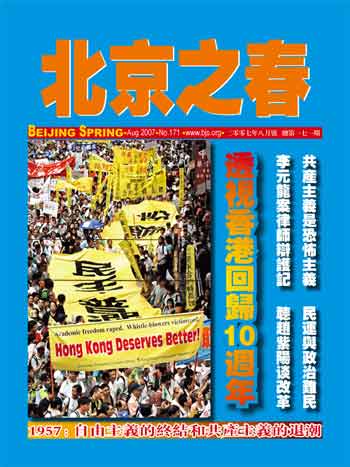
 Aug 2007
 This Month
 Achivements
 Cover pages
 Support
 about us
 Beijing
spring Aug 2007, Issue 171
Beijing
spring Aug 2007, Issue 171